
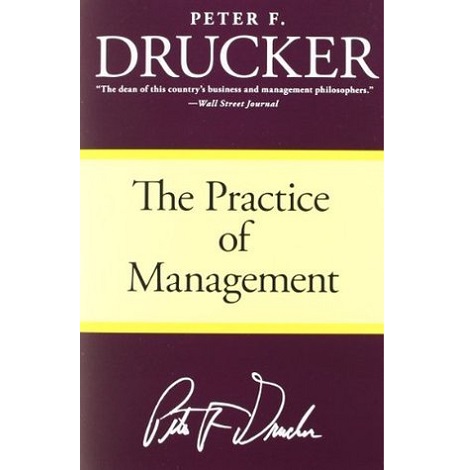
Few business books have influenced modern management thinking as profoundly as The Practice of Management by Peter F. Drucker. First published in 1954, the book remains one of the most respected works in business literature and continues to shape how organizations approach leadership, productivity, decision-making, and organizational effectiveness.
Long before management became a popular academic discipline, Drucker treated it as both a science and a human-centered practice. He believed that businesses exist not merely to generate profit but to create customers, develop people, and contribute meaningfully to society. This philosophy transformed management from a narrow administrative function into a broader responsibility involving leadership, innovation, communication, and long-term vision.
What makes The Practice of Management remarkable is its lasting relevance. Despite being written decades ago, many of its ideas feel surprisingly modern. In an era dominated by digital transformation, startups, remote work, and rapid technological change, Drucker’s principles continue to provide clarity and direction.
This book is not simply a manual for executives. It is a deep examination of how organizations function, why leadership matters, and how managers can build productive, ethical, and sustainable institutions. For business students, entrepreneurs, managers, and aspiring leaders, the book remains an essential foundation in management thinking.
The Central Philosophy: Management as a Human Activity
At the core of Drucker’s philosophy is the belief that management is fundamentally about people. While many business thinkers focus heavily on systems, profits, and efficiency, Drucker consistently emphasizes human potential and responsibility.
He argues that organizations succeed not because of structures alone but because of the people working within them. Managers are therefore responsible for enabling employees to perform effectively, grow professionally, and contribute meaningfully to organizational goals.
This perspective was revolutionary for its time. During the mid-20th century, many businesses viewed workers primarily as labor resources. Drucker challenged this thinking by recognizing employees as knowledge contributors capable of innovation, creativity, and independent judgment.
His approach laid the groundwork for modern concepts such as:
- Employee empowerment
- Knowledge work
- Organizational culture
- Leadership development
- Decentralized management
Today, these ideas are considered standard management principles, but Drucker introduced them decades before they became mainstream.
The Purpose of Business: Creating a Customer
One of the book’s most influential arguments is Drucker’s assertion that the purpose of a business is “to create a customer.”
This idea shifts attention away from profit as the primary objective. According to Drucker, profit is essential for survival, but it is not the true purpose of business. Businesses exist because they solve problems and meet customer needs.
This customer-centered philosophy transformed management thinking by encouraging organizations to focus on:
- Customer satisfaction
- Innovation
- Product value
- Market understanding
- Long-term relationships
In today’s competitive economy, where customer experience often determines success, Drucker’s insights feel particularly relevant. Companies that ignore customer needs may achieve short-term gains, but they rarely sustain long-term growth.
The brilliance of Drucker’s argument lies in its simplicity. By focusing on customer value, organizations naturally improve strategy, innovation, and operational effectiveness.
Management by Objectives: Drucker’s Most Influential Concept
Perhaps the most famous contribution from The Practice of Management is the concept of Management by Objectives (MBO).
Drucker believed that employees perform best when they clearly understand:
- Organizational goals
- Their individual responsibilities
- Expected outcomes
- Performance standards
Rather than relying on rigid supervision, MBO encourages collaboration between managers and employees to establish measurable objectives.
This approach improves:
- Accountability
- Motivation
- Productivity
- Communication
- Organizational alignment
The concept became enormously influential in corporate management and continues to shape modern performance systems.
However, Drucker also warns against reducing management to numbers alone. Objectives must support meaningful organizational purposes rather than becoming bureaucratic exercises.
This balance between measurable performance and human judgment remains one of the book’s strongest insights.
The Rise of the Knowledge Worker
One of Drucker’s most visionary ideas was his prediction of the “knowledge worker.”
At a time when industrial labor dominated economies, Drucker recognized that future businesses would increasingly depend on people whose primary asset was knowledge rather than physical labor.
He foresaw the rise of:
- Analysts
- Consultants
- Engineers
- Researchers
- Information professionals
- Creative workers
This prediction proved extraordinarily accurate.
Today’s digital economy is built around knowledge-based industries where intellectual capital often matters more than physical assets. Drucker understood early that managing knowledge workers required different leadership approaches.
Knowledge workers value:
- Autonomy
- Purpose
- Continuous learning
- Creativity
- Meaningful contribution
Traditional command-and-control management styles often fail in such environments.
Drucker’s understanding of this shift demonstrates his remarkable ability to anticipate long-term economic and organizational trends.
Innovation and Entrepreneurship
Although Drucker is often associated with corporate management, The Practice of Management strongly emphasizes innovation.
Drucker argues that businesses cannot survive through efficiency alone. Organizations must continually adapt, improve, and innovate to remain competitive.
Innovation, according to Drucker, is not accidental inspiration but a systematic process involving:
- Observation
- Market understanding
- Problem-solving
- Strategic experimentation
This perspective influenced modern entrepreneurship and startup culture significantly.
Today, innovation is considered essential across industries, from technology startups to healthcare systems. Drucker’s early recognition of innovation as a core managerial responsibility was decades ahead of its time.
Leadership Versus Administration
A major strength of the book is Drucker’s distinction between leadership and administration.
He argues that management is not simply about maintaining procedures or controlling operations. Effective managers must also inspire, guide, and develop people.
Drucker consistently stresses:
- Decision-making quality
- Responsibility
- Ethical leadership
- Strategic thinking
- Communication
This broader definition of leadership remains highly relevant in modern organizations where emotional intelligence and people management are increasingly important.
The book challenges managers to think beyond efficiency and focus on creating organizations that are productive, adaptable, and socially responsible.
Writing Style and Readability
Despite its intellectual depth, The Practice of Management is surprisingly readable.
Drucker writes with clarity, precision, and confidence. His arguments are analytical but accessible, making complex management ideas understandable without oversimplification.
Unlike many academic business texts, the book avoids excessive jargon and theoretical abstraction. Drucker uses practical examples and logical reasoning to explain concepts clearly.
However, modern readers may notice that some sections feel slower or more formal than contemporary business writing. The language reflects the era in which the book was written, and certain organizational examples may feel dated.
Still, the clarity of Drucker’s thinking ensures that the book remains engaging for serious readers interested in leadership and organizational development.
The Book’s Greatest Strength: Timeless Relevance
What separates The Practice of Management from many business books is its timelessness.
Business trends change constantly. Management theories rise and fall. Yet Drucker’s core principles continue to apply across generations because they focus on fundamental organizational realities:
- Human behavior
- Responsibility
- Productivity
- Leadership
- Customer value
- Innovation
Modern management challenges such as remote work, employee engagement, digital transformation, and organizational culture can still be analyzed effectively through Drucker’s framework.
Few business books written over seventy years ago remain this influential or practical.
Criticisms and Limitations
Although The Practice of Management is widely respected, it is not without limitations.
Some Concepts Feel Broad
Drucker often presents large philosophical ideas rather than detailed implementation strategies. Readers seeking highly technical operational frameworks may find certain sections too conceptual.
The book focuses more on managerial thinking than step-by-step execution.
Dated Examples
Because the book was written in the 1950s, some examples reflect industrial-era business environments that differ significantly from today’s global digital economy.
Modern readers may need to reinterpret some ideas within contemporary contexts.
Repetition in Certain Sections
Drucker occasionally revisits the same themes repeatedly, particularly regarding responsibility and objectives. While this reinforces his arguments, some readers may find parts repetitive.
However, these limitations do not significantly reduce the book’s overall value.
Who Should Read The Practice of Management?
This book is especially valuable for:
- Business students
- MBA candidates
- Managers
- Entrepreneurs
- Startup founders
- Executives
- Team leaders
- HR professionals
- Organizational consultants
It is particularly useful for readers who want to understand the philosophy behind effective management rather than just tactical business techniques.
Those interested in leadership development, organizational strategy, and management theory will find the book highly rewarding.
Comparing Drucker to Modern Business Authors
Many modern business books focus on trends, rapid growth strategies, or motivational advice. Drucker’s work stands apart because it emphasizes enduring principles.
Compared to contemporary authors, Drucker is:
- More analytical
- More philosophical
- More focused on organizational responsibility
- Less focused on hype or quick success
His work requires thoughtful reading and reflection rather than passive consumption.
This intellectual seriousness is one reason his ideas continue to influence executives, scholars, and entrepreneurs worldwide.
Final Verdict: A Foundational Masterpiece in Management Literature
The Practice of Management is more than a business book. It is a foundational work that shaped modern management thinking and continues to influence leadership practices around the world.
Peter Drucker understood that successful organizations depend not only on profits or systems but on people, purpose, responsibility, and innovation. His insights into customer value, knowledge work, leadership, and organizational effectiveness remain extraordinarily relevant decades after publication.
While some examples may feel dated, the core principles are timeless. Drucker’s ability to combine strategic thinking with human-centered leadership makes this book essential reading for anyone serious about understanding management.
For aspiring leaders, entrepreneurs, and professionals seeking a deeper understanding of how organizations succeed, The Practice of Management remains one of the most important and insightful business books ever written.
Available Formats
EPUB
Book Innformation In Point
- Book Title: The Practice of Management
- Author: Peter F. Drucker
- Genre: Business, Management, Leadership, Organizational Development
- First Published: 1954
- Publisher: Harper Business
- Language: English
- Number of Pages: Approximately 400+ pages (varies by edition)
- ISBN: 978-0060878979
- Target Audience:
- Business students
- MBA students
- Managers and executives
- Entrepreneurs
- Team leaders
- Organizational consultants
- Leadership professionals
Main Themes of the Book
- Management philosophy
- Leadership and responsibility
- Customer-focused business strategy
- Innovation and entrepreneurship
- Organizational effectiveness
- Productivity and performance
- Human-centered management
- Decision-making and accountability
Key Concepts Covered
- Management by Objectives (MBO)
- Knowledge workers
- Customer creation
- Organizational structure
- Employee productivity
- Leadership development
- Decentralization
- Innovation management
- Strategic planning
Purpose of the Book
The book aims to explain the principles of effective management and leadership. Peter Drucker presents management as a human-centered responsibility focused on productivity, innovation, customer satisfaction, and organizational growth.
Major Strengths
- Timeless management principles
- Clear and analytical writing style
- Strong leadership insights
- Practical organizational concepts
- Influential business philosophy
- Focus on people and productivity
Weaknesses
- Some examples feel outdated
- Certain concepts are broad rather than technical
- Repetition in some sections
- Less focus on modern digital business environments
Why the Book Is Important
- Introduced modern management thinking
- Popularized Management by Objectives (MBO)
- Predicted the rise of knowledge workers
- Influenced generations of business leaders
- Considered a foundation of management education
Best Lessons From the Book
- The purpose of business is to create a customer
- Effective management requires clear objectives
- Leadership is about responsibility and people development
- Innovation is essential for long-term success
- Organizations succeed through productivity and adaptability
Famous Quote From the Book
“The purpose of business is to create and keep a customer.” — Peter F. Drucker
Recommended For
- Future managers and executives
- Leadership students
- MBA and business management students
- Entrepreneurs and startup founders
- HR and organizational development professionals
- Anyone interested in management philosophy and leadership skills
Download Method The Practice of Management by Peter F. Drucker
By Clicking on the below download button, you will initiate the downloading process of The Practice of Management by Peter F. Drucker.The book is available in both ePub and PDF format with a single click, moreover we offer unlimited books for downloading without any spams, bombardment of ads. Flyers and needless links. Your support in regard to sharing with friends, family members, colleagues are always welcome. Do not forget to share your ideas and thoughts in the comment section.
You may also like
The Personal MBA by Josh Kaufman PDF Download
Mein Kampf by Adolf Hitler PDF Download
Steve Jobs by Walter Isaacson PDF Download
Wings of Fire by Abdul A.P.J. Kalam & Arun Tiwari PDF Download

EPUB
Related posts:
 The Psychology of Money by Morgan Housel PDF Download
 Chaos Kings by Scott Patterson PDF Download
 Rich Dad Poor Dad by Robert T. Kiyosaki PDF Download
 Marketing Made Simple by Donald Miller PDF Download
 Take Command by Joe Hart PDF Download
 Revenge of the Tipping Point by Malcolm Gladwell PDF Download
 Never Finished by David Goggins PDF Download
 1929 by Andrew Ross Sorkin PDF Download
 To Sell Is Human by Daniel H. Pink PDF Download
 The Personal MBA by Josh Kaufman PDF Download