
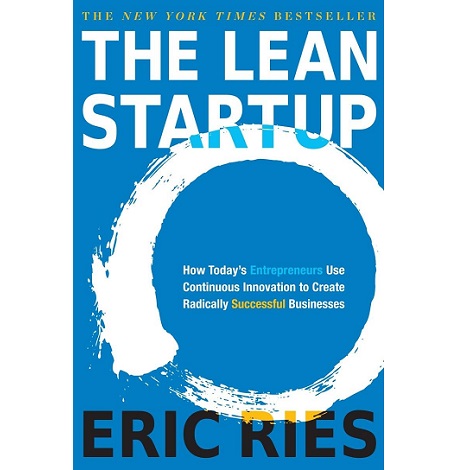
Few business books have changed startup culture as dramatically as The Lean Startup by Eric Ries. Since its publication in 2011, the book has become essential reading for entrepreneurs, startup founders, product managers, marketers, and innovation teams worldwide.
Before the rise of the lean startup movement, many businesses followed traditional models built around extensive planning, large investments, and long product development cycles. Startups often spent years building products before discovering whether customers actually wanted them.
Eric Ries challenged this outdated approach by introducing a faster, smarter, and more adaptable system for building businesses. Instead of relying on assumptions, Ries argues that startups should continuously test ideas, gather customer feedback, and improve products through experimentation.
The result is a business philosophy focused on learning, agility, innovation, and efficient resource management.
What makes The Lean Startup especially influential is that it does not simply offer motivational advice. It provides a practical framework for reducing risk and increasing the chances of building successful products in uncertain markets.
More than a decade after its release, the book continues to shape startup ecosystems, technology companies, and innovation strategies across industries.
Understanding the Core Idea Behind the Lean Startup Method
At the center of the book is the idea that startups operate under conditions of extreme uncertainty. Traditional management systems designed for large corporations often fail in startup environments because startups are still searching for sustainable business models.
Ries defines a startup not merely as a small business but as an organization designed to create something new under uncertain conditions.
Because uncertainty is unavoidable, startups must prioritize learning over perfection.
The Lean Startup methodology focuses on:
- Rapid experimentation
- Customer feedback
- Continuous improvement
- Adaptability
- Data-driven decisions
- Efficient product development
Rather than spending years creating polished products, Ries encourages businesses to launch early versions, test assumptions quickly, and evolve based on real customer behavior.
This shift from prediction to experimentation is the foundation of the book’s philosophy.
The Build-Measure-Learn Feedback Loop
One of the most important concepts introduced in the book is the Build-Measure-Learn feedback loop.
Ries argues that startups should function like scientific experiments. Every product idea represents a hypothesis that must be tested in the real world.
The cycle works in three stages:
Build
Create a basic version of the product quickly.
Measure
Collect data and customer feedback to understand how users respond.
Learn
Analyze the results and decide whether to improve, pivot, or continue the strategy.
This process allows businesses to reduce wasted time, money, and effort.
Instead of relying on assumptions or executive opinions, startups learn directly from customer behavior.
The simplicity of this framework is one reason the book became so influential. It provides entrepreneurs with a practical system for managing uncertainty rather than fearing it.
Minimum Viable Product: A Game-Changing Concept
Perhaps the book’s most famous concept is the Minimum Viable Product (MVP).
An MVP is the simplest version of a product that allows businesses to test key assumptions with minimal resources.
Rather than building complex features immediately, startups launch basic versions to determine:
- Whether customers care
- Which features matter most
- What problems need solving
- How users behave
This idea transformed product development across industries.
Many successful companies used MVP-style approaches during their early growth stages. Instead of waiting for perfection, they prioritized learning and iteration.
The brilliance of the MVP concept lies in its efficiency. It prevents startups from investing heavily in products customers may not want.
However, Ries emphasizes that MVPs should still deliver meaningful value. An unfinished or low-quality product without purpose can damage customer trust.
The goal is not to release bad products but to maximize validated learning.
Validated Learning: Measuring Real Progress
Traditional businesses often measure success using metrics like revenue, downloads, or media attention. Ries argues that startups need a different kind of progress measurement called “validated learning.”
Validated learning focuses on discovering whether business assumptions are actually correct.
For example:
- Do customers genuinely need the product?
- Will they pay for it?
- Does the product solve a meaningful problem?
- Are users returning consistently?
This approach helps startups avoid “vanity metrics” that create the illusion of success without real business sustainability.
Ries repeatedly stresses that learning is the primary goal of early-stage startups. Every experiment should increase understanding about customers and market demand.
This emphasis on evidence-based decision-making makes the book highly practical and analytical.
The Importance of Pivoting
Another major lesson from The Lean Startup is the importance of pivoting.
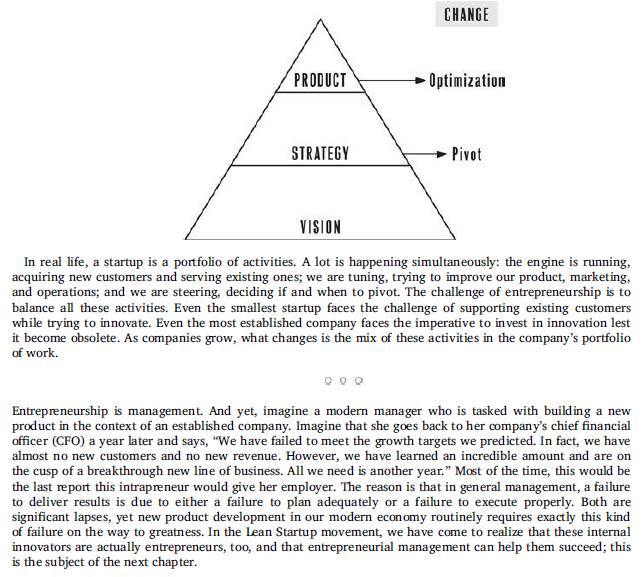
A pivot is a strategic change made when evidence shows that the current business model or product direction is failing.
Many entrepreneurs become emotionally attached to their original ideas. Ries argues that successful startups must remain flexible enough to adapt when customer feedback reveals problems.
Pivoting is not failure. It is a disciplined response to learning.
The book presents several types of pivots, including:
- Customer segment pivots
- Product feature pivots
- Revenue model pivots
- Technology pivots
- Market positioning pivots
This adaptability is one reason many modern startups survive in highly competitive industries.
Rather than blindly continuing ineffective strategies, lean startups evolve continuously based on evidence.
Entrepreneurship as Management
One of the book’s strongest insights is its argument that entrepreneurship is a form of management.
Ries challenges the stereotype that startups succeed through passion and creativity alone. While innovation matters, startups also require disciplined processes, strategic thinking, and organizational learning.
The book introduces management systems specifically designed for uncertainty.
This perspective helped legitimize entrepreneurship as a structured discipline rather than a purely instinctive activity.
Modern startup ecosystems increasingly rely on:
- Data analysis
- Experimentation
- Agile systems
- Product metrics
- Customer development
Much of this thinking was influenced directly by the lean startup movement.
Why the Book Resonates with Modern Startups
The timing of The Lean Startup contributed significantly to its impact.
The book emerged during a period when technology startups were growing rapidly, but many were failing due to poor planning and inefficient product development.
Ries provided a practical solution to common startup problems:
- Building products nobody wants
- Running out of funding too quickly
- Ignoring customer feedback
- Overcomplicating development
- Scaling prematurely
The lean startup methodology aligned perfectly with the fast-moving digital economy where speed, adaptability, and customer understanding became critical competitive advantages.
Today, its principles are used not only by startups but also by:
- Technology companies
- Corporate innovation teams
- Product managers
- Marketing departments
- Nonprofit organizations
The methodology’s flexibility explains its broad influence across industries.
Writing Style and Readability
Eric Ries writes in a conversational yet analytical style that balances theory with practical application.
The book avoids excessive academic complexity while still presenting sophisticated business ideas.
Ries uses:
- Real startup examples
- Case studies
- Personal experiences
- Actionable frameworks
- Clear explanations
This combination keeps the book engaging and accessible even for readers without business backgrounds.
Unlike some entrepreneurship books filled primarily with inspiration, The Lean Startup focuses heavily on systems, experimentation, and decision-making.
The practical tone makes the lessons feel immediately useful rather than purely motivational.
The Book’s Greatest Strength: Practical Application
What truly separates The Lean Startup from many business books is its practicality.
Readers can apply its principles immediately to:
- Startups
- Freelance businesses
- Product launches
- Marketing campaigns
- App development
- Business experiments
The concepts are actionable rather than abstract.
Entrepreneurs often finish the book with a completely different perspective on:
- Product development
- Customer feedback
- Innovation
- Risk management
- Strategic planning
This real-world usefulness is one reason the book became essential reading in startup communities worldwide.
Criticisms and Limitations
Despite its influence, The Lean Startup is not without criticism.
Heavy Focus on Technology Startups
Many examples in the book come from software and technology companies. Readers in traditional industries may need to adapt the concepts to fit their environments.
While the principles are broadly useful, implementation may differ outside tech-driven businesses.
Overemphasis on Speed
Some critics argue that excessive focus on rapid iteration can encourage short-term thinking or underdeveloped products.
Not every business benefits from launching quickly, especially industries requiring high precision, safety, or regulatory compliance.
Limited Discussion of Scaling
The book focuses heavily on early-stage startup learning but spends less time discussing long-term scaling challenges.
Entrepreneurs seeking advanced operational growth strategies may need additional resources later.
Who Should Read The Lean Startup?
This book is ideal for:
- Entrepreneurs
- Startup founders
- Product managers
- App developers
- Innovation teams
- Business students
- Marketers
- Freelancers
- Corporate strategists
It is especially valuable for people launching new products or businesses in uncertain markets.
Even established organizations can benefit from its experimentation and customer-feedback principles.
Lasting Influence on Business and Innovation
The impact of The Lean Startup extends far beyond entrepreneurship literature.
Its ideas influenced:
- Agile product development
- Startup incubators
- Venture capital strategies
- Product management systems
- Innovation culture
- Corporate experimentation frameworks
Terms like “MVP,” “pivot,” and “validated learning” became standard business language partly because of this book.
Few modern business books have shaped startup culture as deeply or as globally.
Final Verdict: A Must-Read for Modern Entrepreneurs
The Lean Startup is more than a startup manual. It is a transformative guide to innovation, experimentation, and intelligent business building.
Eric Ries successfully redefined how entrepreneurs approach uncertainty. Instead of treating failure as disaster, he reframes it as an opportunity for learning and adaptation.
The book’s greatest achievement lies in making entrepreneurship more disciplined, measurable, and customer-focused. Its emphasis on continuous learning, rapid experimentation, and evidence-based decision-making remains highly relevant in today’s fast-changing economy.
While some examples lean heavily toward technology startups, the underlying principles apply broadly across industries and organizational sizes.
For entrepreneurs, product creators, innovators, and business students, The Lean Startup remains one of the most influential and practical business books of the modern era.
Available Formats
EPUB
Book Information In Point
- Book Title: The Lean Startup: How Today’s Entrepreneurs Use Continuous Innovation to Create Radically Successful Businesses
- Author: Eric Ries
- Genre: Business, Entrepreneurship, Startups, Innovation, Management
- First Published: 2011
- Publisher: Crown Currency
- Language: English
- Number of Pages: Approximately 320–350 pages (varies by edition)
- ISBN: 978-0307887894
- Target Audience:
- Entrepreneurs
- Startup founders
- Business students
- Product managers
- App developers
- Innovation teams
- Freelancers and marketers
Main Themes of the Book
- Startup innovation
- Customer feedback
- Rapid experimentation
- Product development
- Business adaptability
- Entrepreneurship management
- Continuous improvement
- Data-driven decision-making
Key Concepts Covered
- Minimum Viable Product (MVP)
- Build-Measure-Learn feedback loop
- Validated learning
- Pivoting strategies
- Innovation accounting
- Agile business development
- Customer-centric product design
- Lean management systems
Purpose of the Book
The book aims to teach entrepreneurs how to build successful businesses through experimentation, customer feedback, and continuous innovation instead of relying on traditional business planning methods.
Major Strengths
- Practical startup strategies
- Easy-to-understand explanations
- Actionable business frameworks
- Strong focus on innovation and adaptability
- Real-world startup examples
- Useful for modern digital businesses
Weaknesses
- Heavy focus on technology startups
- Limited discussion of long-term scaling
- Some concepts may feel repetitive
- Rapid-launch approach may not fit every industry
Why the Book Is Popular
- Introduced the Lean Startup methodology
- Popularized MVP and pivot concepts
- Influenced startup culture worldwide
- Widely used in entrepreneurship programs
- Practical guide for reducing business risk
Best Lessons From the Book
- Launch early and learn quickly
- Customer feedback is essential for growth
- Failure can provide valuable learning
- Innovation requires experimentation
- Businesses should adapt based on evidence, not assumptions
Famous Quote From the Book
“The only way to win is to learn faster than anyone else.” — Eric Ries
Recommended For
- Startup founders
- Entrepreneurs and innovators
- Business management students
- Product development teams
- Digital marketers
- App and software creators
- Anyone interested in modern business strategy
Download Method The Lean Startup by Eric Ries
By Clicking on the below download button, you will initiate the downloading process of The Lean Startup by Eric Ries.The book is available in both ePub and PDF format with a single click, moreover we offer unlimited books for downloading without any spams, bombardment of ads. Flyers and needless links. Your support in regard to sharing with friends, family members, colleagues are always welcome. Do not forget to share your ideas and thoughts in the comment section.
You may also like
The Practice of Management by Peter F. Drucker PDF Download
The Personal MBA by Josh Kaufman PDF Download
Mein Kampf by Adolf Hitler PDF Download
Steve Jobs by Walter Isaacson PDF Download

EPUB
Related posts:
 The Psychology of Money by Morgan Housel PDF Download
 Your Next Five Moves by Patrick Bet-David PDF Download
 Take Command by Joe Hart PDF Download
 Chaos Kings by Scott Patterson PDF Download
 Never Finished by David Goggins PDF Download
 Rich Dad Poor Dad by Robert T. Kiyosaki PDF Download
 The Personal MBA by Josh Kaufman PDF Download
 The Practice of Management by Peter F. Drucker PDF Download