
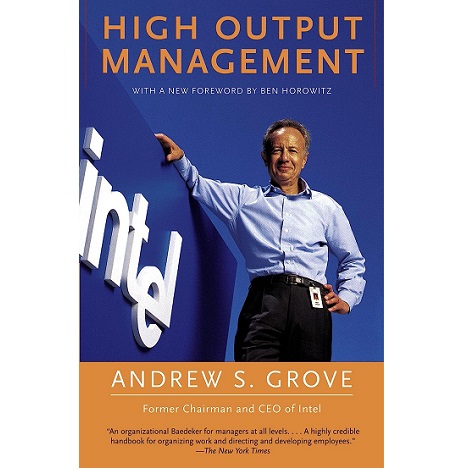
Few management books have earned the enduring respect and influence of High Output Management by Andrew S. Grove. First published in 1983, the book has become a foundational text for executives, entrepreneurs, startup founders, team leaders, and operations managers seeking practical guidance on how to build productive organizations.
Andrew Grove, the legendary former CEO of Intel, was widely recognized for transforming the company into one of the most influential technology firms in the world. Unlike many business authors who write from theoretical perspectives, Grove built his ideas through direct leadership experience in highly competitive environments.
What makes High Output Management especially powerful is its operational focus. While many leadership books emphasize inspiration or abstract philosophy, Grove concentrates on execution, systems, accountability, and measurable productivity. He approaches management with the mindset of an engineer, breaking down organizational performance into understandable and manageable processes.
Despite being written decades ago, the book remains remarkably relevant in modern workplaces. Whether managing startups, remote teams, corporate departments, or fast-growing organizations, many of Grove’s principles still apply directly to contemporary management challenges.
This book is not merely about supervising people. It is about maximizing organizational output through effective communication, strategic decision-making, performance management, and operational clarity.
The Core Philosophy: Management Is About Output
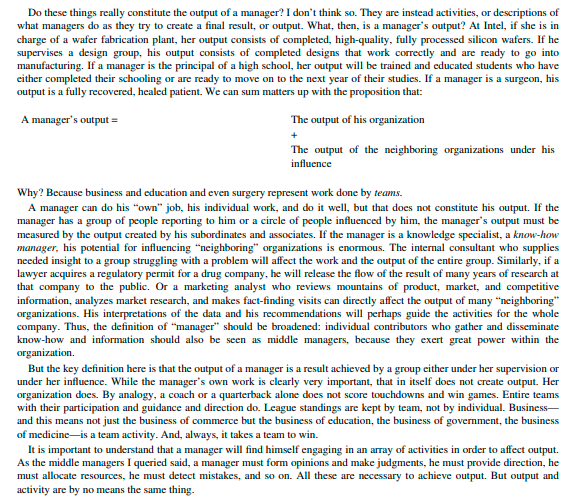
At the center of Grove’s philosophy is a deceptively simple idea: the manager’s role is to maximize the output of their team.
Rather than defining management through authority or status, Grove measures effectiveness through results. According to him, a manager’s success depends not only on personal productivity but on the productivity of everyone they influence.
This perspective changes how leadership is understood.
Managers are not simply administrators. They are force multipliers who improve:
- Team efficiency
- Decision quality
- Communication
- Coordination
- Problem-solving
- Long-term performance
Grove repeatedly emphasizes that management should be approached systematically rather than emotionally or intuitively.
This operational mindset is one reason the book continues to resonate strongly in technology companies and performance-driven organizations.
The Breakfast Factory Analogy
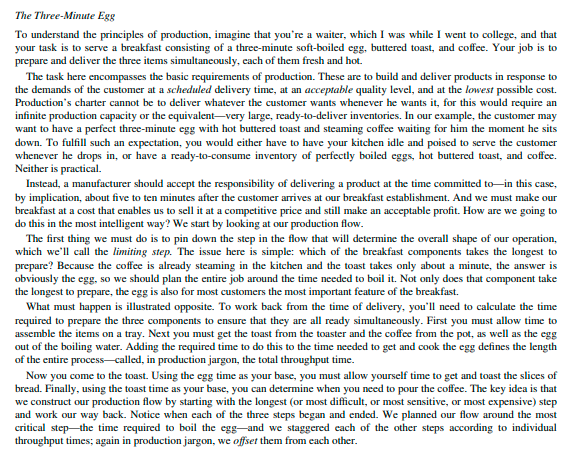
One of the book’s most memorable teaching tools is Grove’s “breakfast factory” analogy.
He compares management processes to running a restaurant kitchen where different tasks must coordinate efficiently to produce quality outcomes consistently.
Through this analogy, Grove explains concepts such as:
- Workflow optimization
- Production bottlenecks
- Quality control
- Resource allocation
- Timing and coordination
The simplicity of the example makes complex operational ideas highly accessible.
Rather than overwhelming readers with corporate jargon, Grove uses relatable systems to explain how organizations function and how managers can improve productivity.
This practical communication style is one of the book’s greatest strengths.
The Importance of Leverage in Management
A central concept in High Output Management is managerial leverage.
Grove argues that effective managers focus on activities that produce the highest impact across the organization.
Examples of high-leverage activities include:
- Training employees
- Improving systems
- Conducting productive meetings
- Making strategic decisions
- Delegating effectively
- Clarifying priorities
The idea is that small managerial actions can create disproportionately large organizational results.
For example, one hour spent properly training employees may save hundreds of hours of future inefficiency.
This concept remains highly relevant in modern workplaces where managers often become overwhelmed by low-value administrative tasks.
Grove teaches readers to think carefully about how their time influences organizational performance.
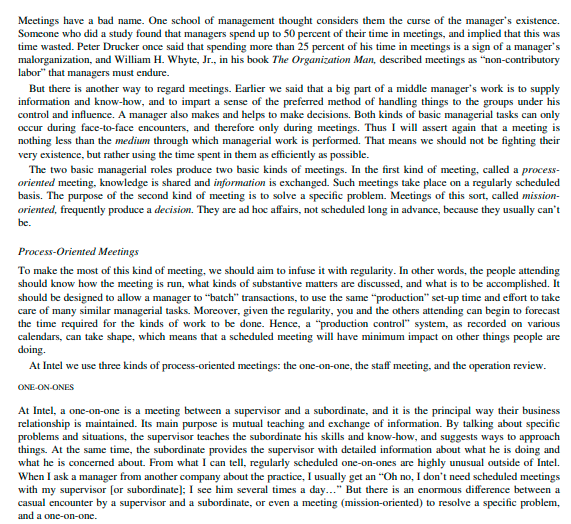
Meetings as Productivity Tools
Many professionals view meetings as unproductive obligations. Grove takes a very different approach.
He argues that meetings are one of the most important tools managers possess when used correctly.
According to Grove, meetings should:
- Share information efficiently
- Solve problems collaboratively
- Clarify decisions
- Align priorities
- Improve coordination
He categorizes meetings into different types, including:
- One-on-one meetings
- Staff meetings
- Operational reviews
- Decision-making discussions
Particularly valuable is his emphasis on one-on-one meetings between managers and employees.
Grove views these meetings not as status updates but as opportunities for coaching, communication, trust-building, and problem-solving.
His insights on meetings remain remarkably applicable in today’s hybrid and remote work environments where communication quality significantly affects productivity.
Task-Relevant Maturity and Leadership Flexibility
Another highly influential idea in the book is “task-relevant maturity.”
Grove argues that employees require different management styles depending on their competence and experience with specific tasks.
Highly skilled employees may need:
- Autonomy
- Strategic guidance
- Minimal supervision
Less experienced employees may require:
- Detailed instruction
- Frequent feedback
- Closer support
This flexible leadership approach resembles what modern management theories call situational leadership.
Grove rejects one-size-fits-all management styles. Instead, he encourages managers to adapt their leadership based on employee capability and task complexity.
This nuanced understanding of leadership demonstrates the depth of Grove’s management thinking.
Performance Measurement and Accountability
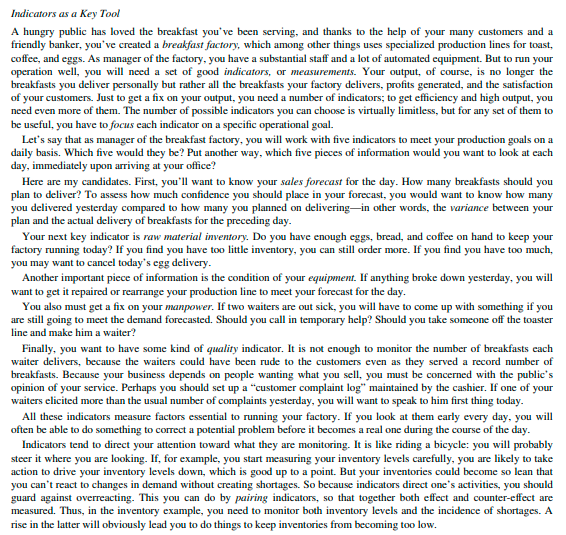
One of the book’s strongest sections focuses on performance measurement.
Grove believes organizations improve when performance expectations are:
- Clear
- Measurable
- Consistently reviewed
However, he also warns against becoming obsessed with metrics alone.
Good measurement systems should support meaningful organizational goals rather than encourage manipulation or bureaucracy.
The book discusses:
- Key performance indicators
- Productivity metrics
- Operational reviews
- Output evaluation
- Organizational accountability
These concepts became highly influential in technology and operations management.
Modern systems like OKRs (Objectives and Key Results), widely used in Silicon Valley, reflect many principles found in Grove’s work.
Decision-Making Under Pressure
One reason High Output Management feels authentic is Grove’s understanding of uncertainty and pressure.
As a leader in the fast-moving semiconductor industry, Grove managed environments where delays and poor decisions carried enormous consequences.
The book teaches managers to:
- Make informed decisions quickly
- Prioritize effectively
- Handle ambiguity
- Respond to operational challenges
- Balance long-term and short-term thinking
Grove’s emphasis on disciplined decision-making remains especially valuable in modern industries characterized by rapid change and intense competition.
Training as a Core Management Responsibility
A recurring theme throughout the book is the importance of employee development.
Grove famously states that training is one of the highest-leverage activities managers can perform.
He views training not as an HR responsibility alone but as a central managerial duty.
Managers who invest in employee development improve:
- Team productivity
- Organizational consistency
- Long-term scalability
- Employee confidence
- Operational quality
This people-development mindset separates strong managers from purely administrative supervisors.
Even today, organizations increasingly recognize that continuous learning is essential for maintaining competitive advantage.
Writing Style: Direct, Practical, and Analytical
Unlike many leadership books filled with motivational storytelling, High Output Management is deeply practical.
Grove writes with clarity, precision, and operational focus.
His style reflects his engineering background:
- Logical explanations
- Structured frameworks
- Real business examples
- Process-oriented thinking
- Clear recommendations
The book avoids unnecessary complexity while still presenting sophisticated managerial insights.
Some readers may find the tone more technical than inspirational, but this practicality is precisely what makes the book so respected among serious managers and executives.
It reads less like a motivational manifesto and more like a highly effective management operating manual.
The Book’s Greatest Strength: Actionable Management Wisdom
The greatest strength of High Output Management is its applicability.
Readers can immediately apply Grove’s ideas to:
- Team leadership
- Productivity improvement
- Performance reviews
- Organizational communication
- Delegation
- Decision-making
- Employee development
Unlike many business books that focus on broad philosophy, Grove consistently translates ideas into operational behavior.
This practicality explains why the book remains widely recommended in:
- Startup communities
- Executive leadership programs
- Product management circles
- Technology companies
- MBA reading lists
Even decades after publication, the lessons remain highly usable.
Criticisms and Limitations
Although the book is widely praised, it has some limitations.
Strong Operational Focus
Grove emphasizes systems, metrics, and productivity heavily. Readers seeking emotional leadership, workplace culture development, or inspirational storytelling may find the book somewhat mechanical.
The focus is primarily on execution and operational efficiency.
Some Examples Feel Dated
Because the book was written in the early 1980s, certain examples reflect manufacturing and industrial management environments.
Modern readers may need to adapt some concepts to digital workplaces or creative industries.
However, the underlying principles remain surprisingly relevant.
Less Attention to Emotional Intelligence
Compared to modern leadership books, Grove spends less time discussing emotional intelligence, workplace wellness, or diversity management.
Contemporary leadership theory has expanded significantly in these areas since the book’s publication.
Still, this does not diminish the book’s operational value.
Who Should Read High Output Management?
This book is especially valuable for:
- Managers
- Startup founders
- Team leaders
- Product managers
- Operations professionals
- Entrepreneurs
- Executives
- MBA students
- Technology professionals
It is particularly useful for individuals managing teams, scaling organizations, or improving operational efficiency.
Readers interested in practical leadership rather than motivational theory will gain tremendous value from the book.
Influence on Modern Management and Silicon Valley
High Output Management has had enormous influence within the technology industry.
Many Silicon Valley leaders, including startup founders and executives, openly recommend the book.
Its impact can be seen in:
- Startup management systems
- Product team structures
- Performance frameworks
- Operational scaling methods
- Leadership development practices
The book’s focus on measurable output, communication, and organizational leverage aligns closely with modern technology company culture.
Its influence remains especially strong in high-performance startup environments.
Final Verdict: One of the Most Practical Management Books Ever Written
High Output Management is not simply a leadership book. It is a highly practical framework for building productive organizations and becoming a more effective manager.
Andrew Grove combines operational discipline with intelligent leadership principles to create a timeless guide for modern management. His focus on leverage, productivity, communication, training, and accountability continues to resonate across industries and generations.
While some examples may feel dated and the tone occasionally technical, the core lessons remain exceptionally valuable. Few business books provide such actionable insight into how managers can improve both individual and organizational performance.
For anyone serious about leadership, operational excellence, and team management, High Output Management remains one of the most insightful and influential business books ever written.
Available Formats
EPUB
Book Innformation In Point
- Book Title: High Output Management
- Author: Andrew S. Grove
- Genre: Business, Management, Leadership, Productivity
- First Published: 1983
- Publisher: Vintage Books
- Language: English
- Number of Pages: Approximately 240–280 pages (varies by edition)
- ISBN: 978-0679762881
- Target Audience:
- Managers and executives
- Startup founders
- Team leaders
- Product managers
- Entrepreneurs
- MBA and business students
- Operations professionals
Main Themes of the Book
- Leadership and productivity
- Operational management
- Team performance
- Decision-making
- Communication and meetings
- Employee development
- Organizational efficiency
- Management systems
Key Concepts Covered
- Managerial leverage
- Task-relevant maturity
- One-on-one meetings
- Performance measurement
- Output-focused management
- Training and employee growth
- Workflow optimization
- Accountability systems
Purpose of the Book
The book aims to teach managers how to improve team productivity, organizational efficiency, and leadership effectiveness through practical management systems and operational thinking.
Major Strengths
- Highly practical management advice
- Clear and analytical writing style
- Actionable leadership strategies
- Strong focus on productivity and execution
- Useful for both startups and large organizations
- Timeless operational insights
Weaknesses
- Some examples feel outdated
- Heavy focus on operational efficiency
- Less emphasis on emotional intelligence
- Technical tone in certain sections
Why the Book Is Popular
- Written by former Intel CEO Andrew Grove
- Widely recommended in Silicon Valley
- Practical guide for modern managers
- Influenced startup and tech leadership culture
- Focuses on measurable business results
Best Lessons From the Book
- A manager’s job is to maximize team output
- Training employees creates long-term productivity
- Meetings should improve communication and decision-making
- High-leverage activities create the greatest impact
- Leadership styles should adapt to employee capability
Famous Quote From the Book
“The output of a manager is the output of the organizational units under his or her supervision.” — Andrew S. Grove
Recommended For
- New and experienced managers
- Startup founders and entrepreneurs
- Product and operations managers
- MBA students
- Team leaders in technology companies
- Professionals interested in productivity and leadership skills
Download Method High Output Management by Andrew S. Grove
By Clicking on the below download button, you will initiate the downloading process of High Output Management by Andrew S. Grove.The book is available in both ePub and PDF format with a single click, moreover we offer unlimited books for downloading without any spams, bombardment of ads. Flyers and needless links. Your support in regard to sharing with friends, family members, colleagues are always welcome. Do not forget to share your ideas and thoughts in the comment section.

Related posts:
 The Psychology of Money by Morgan Housel PDF Download
 Your Next Five Moves by Patrick Bet-David PDF Download
 Take Command by Joe Hart PDF Download
 Chaos Kings by Scott Patterson PDF Download
 Never Finished by David Goggins PDF Download
 Rich Dad Poor Dad by Robert T. Kiyosaki PDF Download
 The Personal MBA by Josh Kaufman PDF Download
 The Practice of Management by Peter F. Drucker PDF Download
 The Lean Startup by Eric Ries PDF Download