
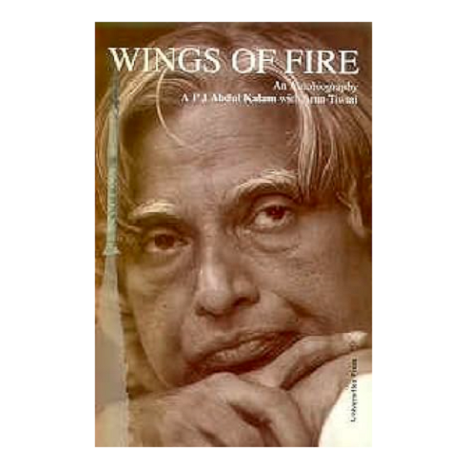
Few autobiographies have inspired generations of students and readers as profoundly as Wings of Fire. Written by A. P. J. Abdul Kalam with the assistance of Arun Tiwari, the book chronicles the remarkable journey of a boy from a modest background in Rameswaram who rose to become one of India’s most respected scientists and eventually the President of India.
More than a personal memoir, Wings of Fire is a reflection on perseverance, education, scientific ambition, spirituality, leadership, and national development. It presents a life shaped not by privilege but by discipline, curiosity, resilience, and unwavering commitment to service.
What makes the autobiography especially powerful is its simplicity. Kalam’s life story is extraordinary, yet he narrates it with humility and sincerity. Rather than glorifying success, the book emphasizes hard work, learning from failure, teamwork, and dedication to a larger purpose.
The result is a deeply motivational and intellectually engaging memoir that continues to resonate with students, educators, scientists, and readers around the world.
A Story of Humble Beginnings and Extraordinary Aspirations
One of the most compelling aspects of Wings of Fire is the contrast between Kalam’s modest upbringing and his later achievements.
Born in the small town of Rameswaram in Tamil Nadu, Kalam grew up in a financially limited but morally rich household. His father, though not formally educated, possessed wisdom, discipline, and spiritual depth that deeply influenced Kalam’s worldview.
The early chapters of the book vividly capture:
- The simplicity of village life
- Strong family values
- Religious harmony
- Community relationships
- The importance of education
These formative experiences become the foundation of Kalam’s later character and leadership style.
Importantly, the book does not romanticize poverty. Instead, it shows how discipline, support, and determination can help individuals rise above material limitations.
Educational Journey: Curiosity as a Driving Force
Education plays a central role throughout the autobiography.
Kalam’s academic journey is presented not as effortless brilliance but as continuous learning fueled by curiosity and persistence. He openly discusses struggles, setbacks, and moments of self-doubt.
This honesty makes his success feel attainable rather than mythical.
The memoir highlights several important influences:
- Inspirational teachers
- Mentorship
- Scientific curiosity
- Personal discipline
Kalam repeatedly emphasizes the transformative power of education, particularly science and technology, in shaping both individual lives and national progress.
For students, these sections are especially motivating because they demonstrate that greatness is built gradually through consistent effort.
Career in Science and India’s Space Program
The heart of Wings of Fire lies in Kalam’s scientific career and contributions to India’s aerospace and missile development programs.
His work with organizations such as:
- Indian Space Research Organisation
- Defence Research and Development Organisation
forms the backbone of the narrative’s middle sections.
Kalam provides detailed insight into:
- Rocket engineering
- Satellite launch vehicle development
- Team collaboration
- Scientific innovation
- National technological ambitions
One of the memoir’s greatest strengths is how it makes scientific achievement emotionally engaging. Technical projects are framed not merely as engineering tasks but as collective national missions.
The development of India’s missile and space capabilities becomes symbolic of self-reliance and national confidence.
The Importance of Failure in the Narrative
Unlike many success stories that focus exclusively on achievement, Wings of Fire gives significant attention to failure.
Kalam openly describes unsuccessful launches, technical setbacks, and professional disappointments. However, these moments are presented as essential parts of growth rather than sources of defeat.
This perspective becomes one of the memoir’s most valuable lessons.
According to Kalam:
- Failure teaches resilience
- Leadership requires accountability
- Success emerges through persistence
One memorable aspect of the narrative is Kalam’s admiration for leaders who protected their teams during failure while sharing credit during success.
These reflections offer meaningful lessons in ethical leadership and organizational culture.
Leadership Philosophy: Service Before Recognition
Throughout the memoir, Kalam consistently portrays leadership as service rather than authority.
He emphasizes qualities such as:
- Humility
- Collaboration
- Integrity
- Vision
- Accountability
Even after achieving national recognition, Kalam’s tone remains modest and grounded.
He repeatedly credits:
- Teachers
- Colleagues
- Scientists
- Mentors
- Team members
for his accomplishments.
This humility distinguishes Wings of Fire from autobiographies centered on self-celebration. The narrative focuses less on personal fame and more on collective achievement and national progress.
Spirituality and Scientific Thinking Coexisting
One of the most distinctive features of the book is its integration of spirituality and science.
Kalam does not view scientific inquiry and spiritual belief as opposing forces. Instead, he presents them as complementary dimensions of human understanding.
The memoir reflects:
- Respect for multiple religions
- Inner discipline
- Ethical responsibility
- Faith in human potential
This balance gives the book philosophical depth beyond its scientific and professional themes.
Kalam’s worldview is rooted in inclusivity and harmony, which contributes significantly to his enduring popularity among diverse audiences.
Literary Style: Simple, Accessible, and Inspirational
The writing style of Wings of Fire is straightforward and accessible, making it appealing to readers across age groups.
Key characteristics of the prose include:
- Clarity and simplicity
- Reflective tone
- Inspirational messaging
- Conversational narration
- Emotional sincerity
Because the language is uncomplicated, the book remains approachable even for younger readers and non-specialists.
Arun Tiwari’s contribution as co-author helps structure the memoir effectively while preserving Kalam’s authentic voice.
The narrative balances personal anecdotes, scientific experiences, and philosophical reflections without becoming overly technical or emotionally exaggerated.
Emotional and Intellectual Impact
The emotional impact of Wings of Fire comes largely from its sincerity.
Kalam’s humility, perseverance, and optimism create an emotional connection with readers. His story inspires not because it appears unattainable, but because it demonstrates how dedication and values can shape extraordinary outcomes.
Intellectually, the memoir also encourages reflection on:
- National development
- Scientific innovation
- Education systems
- Leadership ethics
- Youth empowerment
The book consistently promotes the idea that nations progress through knowledge, discipline, and collective ambition.
Themes Explored in the Memoir
1. Dreams and Ambition
The title itself symbolizes aspiration and limitless potential. Kalam repeatedly encourages young people to dream boldly and work persistently.
2. Education as Transformation
Education is portrayed as the most powerful tool for social mobility and national advancement.
3. Perseverance Through Failure
The memoir strongly emphasizes resilience and learning through setbacks.
4. National Service
Kalam frames scientific achievement as service to society rather than personal success.
5. Humility and Ethics
Despite immense achievements, humility remains central to Kalam’s identity throughout the narrative.
Strengths of the Book
- Highly inspirational without becoming unrealistic
- Accessible writing style
- Honest discussion of failure
- Strong educational value
- Ethical leadership lessons
- Insight into India’s scientific development
- Emotionally sincere storytelling
Limitations and Critical Perspective
A balanced review should also acknowledge some limitations.
1. Limited Emotional Exploration
Kalam maintains emotional restraint throughout much of the memoir. Readers seeking deeply personal emotional analysis may find certain sections less intimate.
2. Technical Sections
Some portions related to engineering and missile development may feel dense for readers uninterested in science and technology.
3. Minimal Political Discussion
Although Kalam later became President of India, the memoir focuses far more on science and personal philosophy than on political analysis.
However, these limitations do not significantly diminish the book’s overall impact.
Enduring Legacy and Cultural Importance
Wings of Fire remains one of the most influential autobiographies in India and beyond.
The book continues to inspire:
- Students
- Scientists
- Teachers
- Entrepreneurs
- Young professionals
It is widely recommended in schools and educational institutions because of its motivational and ethical message.
Kalam himself became known as the “People’s President,” and this memoir reflects the values that earned him that admiration.
Final Verdict: An Inspirational Memoir of Vision and Integrity
Wings of Fire by A. P. J. Abdul Kalam and Arun Tiwari is far more than the autobiography of a scientist—it is a powerful meditation on dreams, discipline, humility, and national service.
Its enduring popularity stems from its authenticity. Kalam’s journey from a small coastal town to scientific leadership and national prominence demonstrates the transformative power of education, perseverance, and ethical purpose.
The memoir succeeds because it inspires readers without simplifying the realities of struggle and failure. It encourages ambition while emphasizing responsibility, collaboration, and integrity.
For readers seeking motivation grounded in sincerity rather than spectacle, Wings of Fire remains an essential and deeply rewarding book.
Available Formats
EPUB

Related posts:
 The Lioness of Boston by Emily Franklin PDF Download
 An American Beauty by Shana Abe PDF Download
 To Die Beautiful by Buzzy Jackson PDF Download
 Viking’s Claim by Mariah Stone PDF Download
 The Invitation by Lucy Foley PDF Download
 TO ENCHANT A LADY’S HEART BY ROBIN LEE HATCHER PDF Download
 The Last Lifeboat by Hazel Gaynor PDF Download
 NO ONE’S BRIDE BY ADELE CLEE PDF Download
 Sisters of Fortune by Anna Lee Huber PDF Download
 The Consequence of Anna by Kate Birkin & Mark Bornz PDF Download