
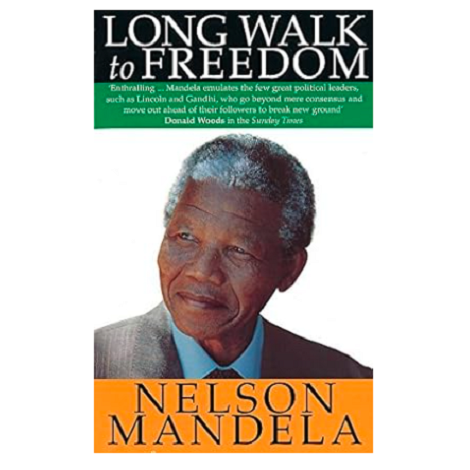
Few autobiographies carry the moral authority, historical weight, and emotional depth of Long Walk to Freedom. Written by Nelson Mandela, this landmark memoir chronicles not only the life of one man but also the painful and transformative history of South Africa during the apartheid era.
More than a political autobiography, the book is a profound meditation on justice, sacrifice, leadership, endurance, and the human cost of systemic oppression. Mandela’s life story unfolds against one of the most brutal racial systems of the twentieth century, yet the narrative consistently rises above bitterness to emphasize reconciliation, dignity, and collective humanity.
What makes Long Walk to Freedom extraordinary is its balance between personal vulnerability and historical documentation. Mandela does not portray himself as a flawless revolutionary hero. Instead, he presents a deeply human account of ambition, fear, mistakes, emotional struggle, and unwavering conviction.
The result is one of the most significant autobiographical works ever published—a book that educates, inspires, and challenges readers intellectually and morally.
Historical Context: A Nation Divided by Apartheid
To fully appreciate the importance of Long Walk to Freedom, it is essential to understand the political landscape that shaped Mandela’s life.
South Africa under apartheid was governed by institutionalized racial segregation designed to maintain white minority rule while systematically oppressing the Black majority. Laws controlled movement, education, employment, housing, and political participation based entirely on race.
Mandela’s autobiography traces this system not through abstract political analysis alone, but through lived experience. Readers witness how apartheid shaped ordinary existence, turning even basic human freedoms into acts of resistance.
The memoir becomes particularly powerful because Mandela situates his personal journey within the larger collective struggle of millions of South Africans. His story is never presented as isolated heroism but as part of a broader movement for justice and equality.
Narrative Structure: From Rural Childhood to Global Statesman
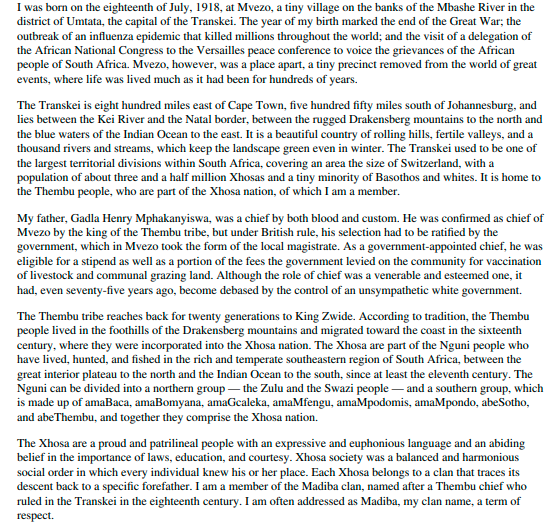
The autobiography follows a chronological structure, tracing Mandela’s evolution from a rural child in the village of Mvezo to a revolutionary activist, political prisoner, and eventually president of South Africa.
The book can broadly be divided into several major phases:
1. Childhood and Early Identity Formation
Mandela begins by describing his upbringing in rural South Africa, emphasizing traditional customs, family influence, and tribal leadership structures.
These early chapters are crucial because they establish the cultural foundation that shaped his sense of dignity, responsibility, and justice.
The simplicity and warmth of these memories also humanize Mandela before the political struggle intensifies.
2. Political Awakening
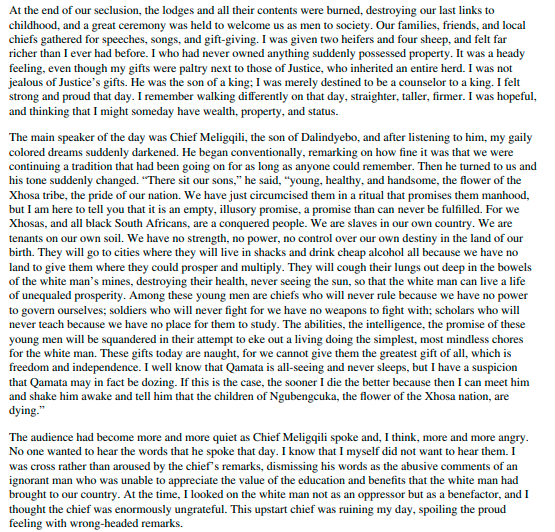
As Mandela moves to Johannesburg, the narrative shifts dramatically. He becomes increasingly aware of racial injustice and systemic inequality.
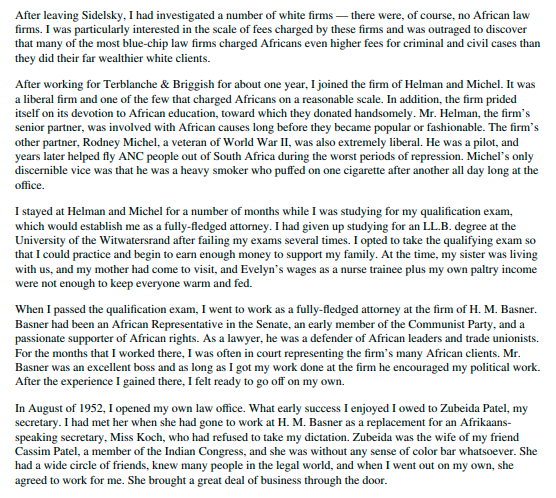
His legal education and involvement with the African National Congress mark the beginning of his political transformation.
This section effectively illustrates how political consciousness develops gradually through lived experience rather than sudden ideological conversion.
3. Resistance and Revolutionary Struggle
The middle portion of the memoir focuses on political activism, state repression, underground resistance, and Mandela’s eventual arrest.
Mandela explains the difficult moral and strategic decisions surrounding armed resistance with remarkable honesty and complexity.
Importantly, he avoids simplistic political rhetoric. Instead, he presents these choices as responses to a system that had eliminated peaceful avenues for meaningful change.
4. Imprisonment on Robben Island
The prison chapters are among the most emotionally powerful sections of the book.
Mandela spent 27 years imprisoned, much of it on Robben Island. Yet these chapters are not dominated by self-pity. Instead, they explore endurance, discipline, emotional resilience, and the psychological challenges of long-term incarceration.
The prison becomes both a site of suffering and a space for intellectual and political growth.
5. Negotiation and Reconciliation
The final sections focus on Mandela’s release, negotiations to end apartheid, and South Africa’s transition toward democracy.
These chapters reveal Mandela’s extraordinary political maturity. Rather than advocating revenge, he emphasizes reconciliation and nation-building.
This commitment to forgiveness without forgetting becomes one of the memoir’s defining moral achievements.

Mandela as Narrator: Humility and Emotional Intelligence
One of the book’s greatest strengths is Mandela’s narrative voice.
Despite his immense historical stature, Mandela writes with humility and restraint. He does not glorify himself or present his life as inevitable greatness.
Instead, he openly acknowledges:
- Personal sacrifices
- Family strain
- Political disagreements
- Emotional hardship
- Moments of fear and uncertainty
This honesty gives the memoir credibility and emotional authenticity.
Mandela’s emotional intelligence is particularly striking. He consistently demonstrates an ability to understand opponents without excusing injustice.
This balance between moral firmness and human empathy distinguishes the autobiography from many political memoirs.
Major Themes Explored in the Memoir
1. Freedom and Human Dignity
Freedom is the central theme of the memoir. However, Mandela defines freedom broadly—not merely as political liberation but as the ability to live with dignity and self-determination.
He repeatedly emphasizes that oppression dehumanizes both the oppressed and the oppressor.
2. Sacrifice and Responsibility
Mandela portrays leadership as deeply connected to sacrifice. His political activism costs him personal comfort, family relationships, and decades of freedom.
The memoir consistently raises difficult questions about the personal cost of political commitment.
3. Reconciliation Over Revenge
Perhaps the most remarkable theme is reconciliation. After decades of imprisonment, Mandela advocates cooperation rather than vengeance.
This moral perspective gives the memoir universal significance beyond South African history.
4. Collective Struggle
Mandela repeatedly reminds readers that history is shaped collectively. He avoids portraying himself as a lone savior and instead honors fellow activists, prisoners, and ordinary citizens.
This emphasis on solidarity strengthens the memoir’s ethical foundation.
Literary Style: Clear, Reflective, and Powerful
Mandela’s writing style is direct, disciplined, and highly readable. The prose avoids excessive ornamentation, yet it carries considerable emotional and intellectual power.
Several qualities define the style:
- Clear narrative structure
- Reflective tone
- Precise historical detail
- Controlled emotional expression
- Strong moral clarity
The restraint in Mandela’s writing often intensifies emotional impact. He describes suffering calmly, allowing readers to fully absorb its significance without manipulation.
The memoir also balances personal storytelling with political explanation effectively, making complex historical events accessible to a broad audience.
Emotional and Intellectual Impact
Long Walk to Freedom succeeds both emotionally and intellectually.
Emotionally, it humanizes historical struggle. Readers witness the loneliness of imprisonment, the strain on Mandela’s family, and the emotional toll of political resistance.
Intellectually, the memoir provides insight into:
- Colonialism
- Systemic racism
- Political organization
- Leadership ethics
- Transitional justice
The book encourages readers to think critically about power, justice, and moral responsibility.
Its educational value is immense, yet it never feels like a textbook.
Strengths of the Memoir
- Extraordinary historical significance
- Deep moral and philosophical insight
- Honest self-reflection
- Balanced political analysis
- Accessible writing style
- Emotional authenticity
- Inspirational without becoming simplistic
Limitations and Critical Perspective
A balanced review should also acknowledge some limitations.
1. Extensive Political Detail
Some readers may find portions of the political negotiations and organizational history dense or slow-paced.
2. Emotional Restraint
Mandela often maintains emotional discipline, which occasionally creates emotional distance from intensely personal experiences.
3. Limited Focus on Family Life
Although Mandela discusses family sacrifices, readers seeking deeper exploration of his personal relationships may find those sections comparatively brief.
However, these limitations are minor relative to the memoir’s overall achievement.
Enduring Legacy and Global Importance
Long Walk to Freedom remains one of the most influential autobiographies ever written because it transcends national history.
The memoir continues to inspire readers worldwide through its messages of:
- Justice
- Forgiveness
- Courage
- Equality
- Democratic values
Mandela’s life story has become a universal symbol of peaceful resistance and moral leadership.
The book is widely studied in:
- Political science
- History
- Human rights education
- Leadership studies
Its relevance remains profound in a world still confronting inequality, racism, and political division.
Final Verdict: A Masterpiece of Political and Human Literature
Long Walk to Freedom by Nelson Mandela is more than an autobiography—it is a monumental historical and moral document that captures the struggle for justice with extraordinary humanity and wisdom.
Mandela’s ability to combine political insight with emotional humility makes this memoir uniquely powerful. It is a story of resistance without hatred, leadership without arrogance, and endurance without surrendering compassion.
The book challenges readers not only to understand history but also to reflect on their own ideas about freedom, justice, and human dignity.
Few autobiographies achieve such a rare balance of historical importance, literary quality, and moral depth.
Available Formats
EPUB
Book Innformation In Point
- Title: Long Walk to Freedom
- Author: Nelson Mandela
- Genre: Autobiography / Political Memoir / Historical Non-fiction
- Writing Style: Reflective, inspiring, historical, analytical
- Main Subject: Nelson Mandela’s life, anti-apartheid struggle, imprisonment, and journey to freedom
- Key Themes: Freedom, justice, sacrifice, leadership, racism, reconciliation, human dignity
- Tone: Powerful, thoughtful, emotional, motivational
- Time Period Covered: Early 20th century to post-apartheid South Africa
- Setting: South Africa during apartheid and democratic transition
- Target Audience: Students, history readers, political science enthusiasts, general readers
- Notable Strengths: Historical insight, emotional honesty, leadership lessons, political depth
- Reading Experience: Educational, inspiring, emotionally impactful
- Global Impact: One of the most influential political autobiographies ever written
Download Method Long Walk to Freedom by Nelson Mandela
By Clicking on the below download button, you will initiate the downloading process of Long Walk to Freedom by Nelson Mandela.The book is available in both ePub and PDF format with a single click, moreover we offer unlimited books for downloading without any spams, bombardment of ads. Flyers and needless links. Your support in regard to sharing with friends, family members, colleagues are always welcome. Do not forget to share your ideas and thoughts in the comment section.
You may also like
The Diary of a Young Girl by Anne Frank PDF Download
Driven to Distraction by Edward M. Hallowell M.D & John J. Ratey M.D PDF Download
Luc and Lila by JodiMarie Meyer PDF Download
Between Steel and Secrets by Willow Fox PDF Download

EPUB
Related posts:
 Secretary Kim by Lisbeth tshithlo pdf download
 Bare The Blesser s Game by Jackie Phamotse pdf Download
 The Lioness of Boston by Emily Franklin PDF Download
 Caged By Them by Kelli Callahan PDF Download
 Thicker Than Water by Kerry Washington PDF Download
 The Pryce Of Loving A Boss by Nai PDF Download
 The Diary of a Young Girl by Anne Frank PDF Download