
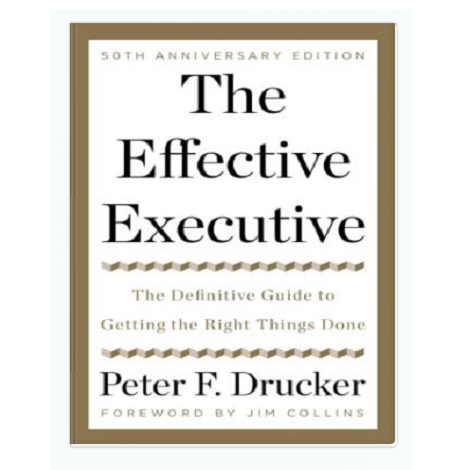
Few business books have maintained their relevance across generations as successfully as The Effective Executive by Peter F. Drucker. First published in 1967, the book continues to influence managers, entrepreneurs, executives, and professionals seeking to improve their productivity and leadership effectiveness.
Unlike many modern productivity books filled with motivational slogans or temporary hacks, Drucker’s work focuses on deeper principles of effectiveness. He argues that success in leadership is not determined by intelligence, talent, or charisma alone. Instead, effective executives achieve results through disciplined habits, strategic thinking, and intentional decision-making.
The book’s core message is both simple and powerful: effectiveness can be learned.
This idea transformed management thinking because it shifted attention away from personality traits and toward practical behaviors that individuals can develop over time.
Although the book was written decades ago, its insights remain highly relevant in today’s fast-moving business environment where professionals constantly face information overload, distractions, and increasing organizational complexity.
The Effective Executive is not simply about becoming more productive. It is about learning how to focus on meaningful contributions, make better decisions, manage time wisely, and create long-term organizational impact.
For anyone seeking practical wisdom on leadership and professional effectiveness, the book remains one of the most respected management classics ever written.
The Central Philosophy: Effectiveness Is a Learnable Skill
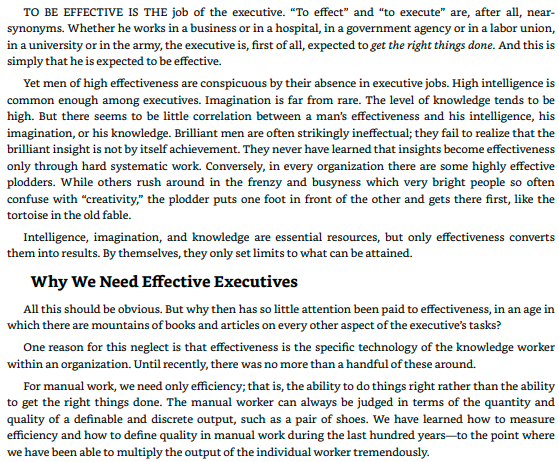
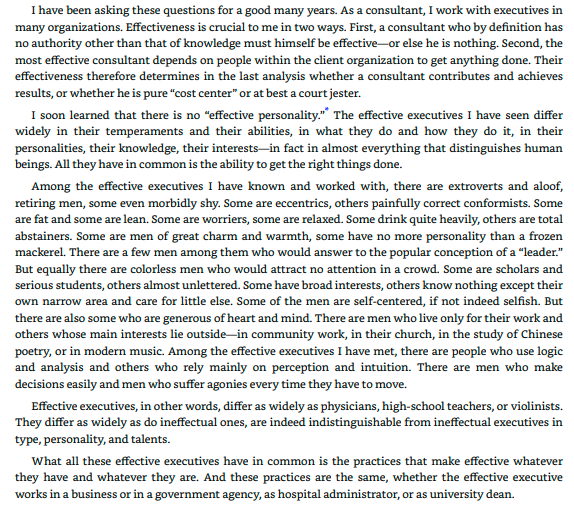
At the heart of Drucker’s philosophy is the belief that effectiveness is not an inborn talent.
Many people assume successful executives possess extraordinary intelligence or natural leadership abilities. Drucker disagrees. He argues that effective executives develop habits and systems that allow them to produce meaningful results consistently.
This perspective is empowering because it suggests that effectiveness is accessible to anyone willing to practice disciplined management behaviors.
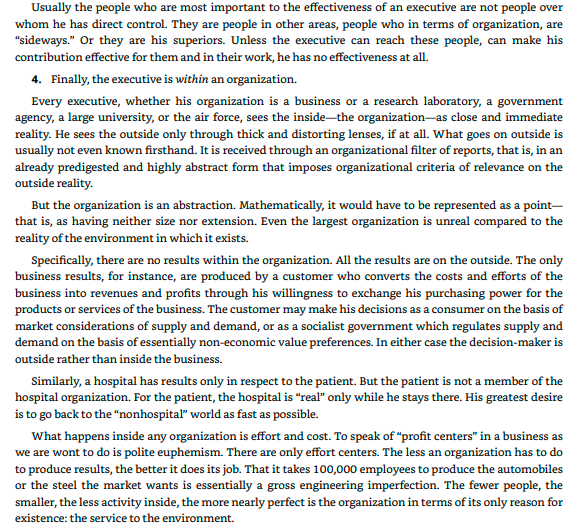
According to Drucker, organizations increasingly depend on “knowledge workers” — individuals whose primary contribution comes from thinking, analysis, communication, and decision-making rather than physical labor.
Because knowledge work is less visible and harder to measure, personal effectiveness becomes critically important.
Drucker identifies several core practices that effective executives consistently follow:
- Managing time carefully
- Focusing on contribution
- Prioritizing strengths
- Concentrating on important tasks
- Making sound decisions
These principles form the foundation of the book.
Time Management: The Foundation of Effectiveness
One of the book’s strongest and most practical sections focuses on time management.
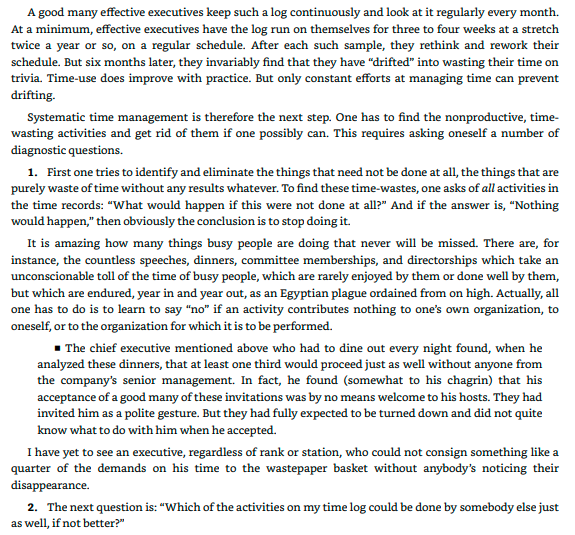
Drucker argues that time is the scarcest and most valuable resource for executives. Unlike money or staff, time cannot be replaced once lost.
He observes that many professionals underestimate how much time they waste through:
- Unnecessary meetings
- Interruptions
- Poor planning
- Administrative inefficiency
- Lack of focus
Rather than relying on productivity tricks, Drucker recommends systematic time analysis.
He encourages readers to:
- Record how they actually spend time
- Eliminate nonessential activities
- Consolidate time into larger productive blocks
This disciplined approach remains remarkably relevant today, especially in workplaces dominated by digital distractions and constant communication.
Drucker’s understanding of time management goes beyond efficiency. He believes controlling time is essential for strategic thinking and meaningful contribution.
Focus on Contribution Instead of Activity
A major insight from The Effective Executive is Drucker’s emphasis on contribution.
Many professionals measure productivity by activity levels:
- Responding to emails
- Attending meetings
- Completing tasks
- Staying busy
Drucker challenges this mindset.
He argues that effectiveness depends not on effort alone but on meaningful results. Executives should constantly ask:
“What can I contribute that will significantly improve organizational performance?”
This shift from activity to contribution changes how leaders prioritize work.
Instead of focusing on routine tasks, effective executives concentrate on:
- Long-term impact
- Organizational goals
- Strategic value
- Customer outcomes
- Team development
This principle remains especially important in modern workplaces where busyness is often confused with productivity.
Drucker reminds readers that meaningful contribution is what ultimately creates value.
Building on Strengths Rather Than Weaknesses
Another powerful concept in the book is Drucker’s focus on strengths.
He argues that effective organizations succeed by maximizing strengths rather than obsessing over weaknesses.
This applies to:
- Individuals
- Teams
- Leadership structures
- Organizational systems
Drucker believes managers should place people in roles where their strengths can produce the greatest results.
Rather than trying to make everyone equally good at everything, organizations should develop environments where talent can thrive.
This philosophy strongly influenced modern leadership development and strengths-based management approaches.
Today, many organizations emphasize employee strengths, engagement, and specialization — ideas Drucker advocated decades earlier.
The Importance of Prioritization
One of the book’s most enduring lessons involves concentration and prioritization.
Drucker warns that executives often spread themselves too thin across too many responsibilities.
Effective executives focus intensely on a small number of high-priority tasks rather than attempting to do everything simultaneously.
This requires:
- Saying no strategically
- Eliminating low-value activities
- Delegating appropriately
- Concentrating resources effectively
Drucker argues that concentration creates impact because meaningful results require sustained attention.
In today’s environment of multitasking and constant interruptions, this principle feels more relevant than ever.
The book repeatedly emphasizes that clarity and focus are essential for long-term effectiveness.
Decision-Making as a Core Executive Responsibility
Another standout aspect of the book is Drucker’s analysis of decision-making.
He argues that executives are fundamentally responsible for making judgments that affect organizations, employees, and long-term strategy.
Good decisions require:
- Understanding problems clearly
- Distinguishing symptoms from root causes
- Gathering relevant information
- Considering alternatives
- Balancing risk and opportunity
Drucker discourages impulsive decision-making driven by emotions or short-term pressure.
Instead, he advocates thoughtful analysis combined with decisive action.
Importantly, Drucker also recognizes that no executive can avoid mistakes entirely. The goal is not perfection but disciplined judgment and continuous learning.
This realistic perspective gives the book practical credibility.
Knowledge Work and Modern Relevance
One reason The Effective Executive remains so influential is Drucker’s early understanding of knowledge work.
Long before the digital economy emerged, Drucker recognized that future organizations would increasingly depend on employees whose primary tools were:
- Information
- Analysis
- Communication
- Creativity
- Problem-solving
Today’s professionals constantly manage emails, digital meetings, reports, and information streams.
Drucker’s principles provide valuable guidance for navigating this complexity:
- Focus on priorities
- Protect productive time
- Avoid unnecessary activity
- Pursue meaningful contribution
His insights feel remarkably modern despite being written decades ago.
Writing Style: Clear, Thoughtful, and Practical
Drucker’s writing style is analytical yet highly accessible.
Unlike many business books filled with motivational exaggeration, The Effective Executive maintains a calm, thoughtful tone grounded in observation and logic.
The book avoids unnecessary jargon while still presenting sophisticated ideas.
Drucker writes with:
- Clarity
- Precision
- Practical wisdom
- Intellectual depth
He supports concepts through examples and managerial observations rather than abstract theory alone.
Some readers may find the pacing slower compared to modern business books, but the depth of insight rewards careful reading.
This is a book designed for reflection rather than quick consumption.
The Book’s Greatest Strength: Timeless Practical Wisdom
The greatest strength of The Effective Executive is its timeless practicality.
The book addresses universal professional challenges:
- Managing limited time
- Making decisions
- Prioritizing effectively
- Leading responsibly
- Producing meaningful results
Unlike trend-based business books tied to specific industries or technologies, Drucker focuses on enduring principles of effectiveness.
This timelessness explains why the book remains widely recommended by:
- Executives
- Entrepreneurs
- MBA programs
- Leadership coaches
- Management consultants
Its lessons apply equally to corporate leaders, startup founders, nonprofit directors, and independent professionals.
Criticisms and Limitations
Although the book is highly respected, it has some limitations.
Less Focus on Emotional Intelligence
Modern leadership literature places significant emphasis on emotional intelligence, empathy, and workplace culture.
Drucker discusses relationships and responsibility but spends less time exploring emotional dynamics compared to contemporary leadership books.
Formal Writing Style
Because the book was written in the 1960s, some readers may find the language more formal and slower-paced than modern productivity literature.
However, the clarity of thought compensates for the older style.
Limited Tactical Productivity Systems
Readers looking for detailed productivity tools or step-by-step workflows may find the book more philosophical than tactical.
Drucker focuses on principles and habits rather than rigid systems.
Still, this broader perspective contributes to the book’s lasting relevance.
Who Should Read The Effective Executive?
This book is ideal for:
- Executives
- Managers
- Entrepreneurs
- Team leaders
- Knowledge workers
- MBA students
- Consultants
- Professionals seeking productivity improvement
It is especially valuable for individuals in leadership or decision-making roles.
Readers interested in long-term professional effectiveness rather than short-term productivity tricks will benefit most from the book.
Influence on Modern Leadership and Productivity Thinking
The Effective Executive influenced generations of management thinkers and leadership experts.
Many modern productivity concepts reflect Drucker’s ideas about:
- Time management
- Strategic focus
- Knowledge work
- Contribution
- Prioritization
His influence extends across:
- Corporate leadership
- Organizational strategy
- Productivity systems
- Executive coaching
- Management education
Few business books have shaped modern professional thinking so deeply.
Final Verdict: One of the Greatest Books on Professional Effectiveness Ever Written
The Effective Executive remains one of the most insightful and practical books ever written on leadership, productivity, and professional performance.
Peter Drucker understood that effectiveness is not about working endlessly or appearing busy. It is about producing meaningful results through disciplined thinking, strategic focus, and intelligent decision-making.
The book’s lessons on time management, prioritization, contribution, strengths, and leadership continue to apply across industries and generations.
While some sections reflect the era in which the book was written, its core principles remain timeless. Drucker’s wisdom cuts through distractions and reminds readers what truly matters in professional life.
For managers, entrepreneurs, executives, and knowledge workers seeking lasting effectiveness rather than temporary productivity hacks, The Effective Executive remains an essential and deeply rewarding read.
Available Formats
EPUB
Book Innformation In Point
- Book Title: The Effective Executive: The Definitive Guide to Getting the Right Things Done
- Author: Peter F. Drucker
- Genre: Business, Leadership, Productivity, Management, Self-Development
- First Published: 1967
- Publisher: Harper Business
- Language: English
- Number of Pages: Approximately 180–220 pages (varies by edition)
- ISBN: 978-0060833459
- Target Audience:
- Executives and managers
- Entrepreneurs
- Team leaders
- Business students
- Knowledge workers
- Consultants
- Professionals seeking productivity improvement
Main Themes of the Book
- Executive effectiveness
- Time management
- Leadership and decision-making
- Productivity and focus
- Strategic contribution
- Strength-based management
- Organizational performance
- Knowledge work
Key Concepts Covered
- Managing time effectively
- Focusing on contribution
- Prioritization and concentration
- Decision-making processes
- Building on strengths
- Executive responsibility
- Productivity habits
- Organizational effectiveness
Purpose of the Book
The book aims to teach professionals and leaders how to become more effective through disciplined habits, strategic thinking, better time management, and focused decision-making.
Major Strengths
- Timeless leadership principles
- Practical productivity advice
- Clear and thoughtful writing style
- Strong focus on effectiveness over busyness
- Applicable across industries and professions
- Deep insights into executive responsibility
Weaknesses
- Formal writing style compared to modern books
- Less emphasis on emotional intelligence
- Limited step-by-step productivity systems
- Some examples feel dated
Why the Book Is Popular
- Written by legendary management thinker Peter Drucker
- Widely recommended in leadership and MBA programs
- Focuses on long-term professional effectiveness
- Influenced modern productivity and management thinking
- Provides practical and timeless executive advice
Best Lessons From the Book
- Effectiveness can be learned
- Time is the most valuable resource
- Focus on meaningful contribution rather than activity
- Build on strengths instead of fixing weaknesses constantly
- Prioritize important tasks and eliminate distractions
Famous Quote From the Book
“Effectiveness can be learned.” — Peter F. Drucker
Recommended For
- Executives and business leaders
- Entrepreneurs and startup founders
- Managers and team leaders
- MBA and business management students
- Productivity-focused professionals
- Consultants and knowledge workers
- Anyone seeking long-term professional effectiveness
Download Method The Effective Executive by Peter F. Drucker
By Clicking on the below download button, you will initiate the downloading process of The Effective Executive by Peter F. Drucker.The book is available in both ePub and PDF format with a single click, moreover we offer unlimited books for downloading without any spams, bombardment of ads. Flyers and needless links. Your support in regard to sharing with friends, family members, colleagues are always welcome. Do not forget to share your ideas and thoughts in the comment section.
You may also like
Business Model Generation by Alexander Osterwalder & Yves Pigneur PDF Download
High Output Management by Andrew S. Grove PDF Download
The Lean Startup by Eric Ries PDF Download
The Practice of Management by Peter F. Drucker PDF Download

EPUB
Related posts:
 The Psychology of Money by Morgan Housel PDF Download
 Your Next Five Moves by Patrick Bet-David PDF Download
 Take Command by Joe Hart PDF Download
 Chaos Kings by Scott Patterson PDF Download
 Never Finished by David Goggins PDF Download
 Rich Dad Poor Dad by Robert T. Kiyosaki PDF Download
 The Personal MBA by Josh Kaufman PDF Download
 The Practice of Management by Peter F. Drucker PDF Download
 The Lean Startup by Eric Ries PDF Download
 High Output Management by Andrew S. Grove PDF Download