
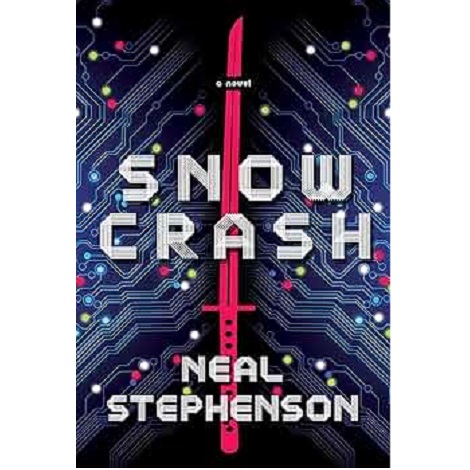
Snow Crash by Neal Stephenson is one of the most influential and unconventional works in modern science fiction. Published in 1992, the novel blends cyberpunk aesthetics, linguistic theory, ancient mythology, corporate satire, and virtual reality into a fast-paced and often overwhelming narrative. It is a book that does not simply tell a story—it builds an entire conceptual framework for how language, culture, and technology intersect.
Often described as chaotic, hyper-stimulated, and densely packed with ideas, Snow Crash stands as both a visionary cyberpunk novel and a satirical critique of late-stage capitalism and information overload. This review examines its structure, themes, characters, writing style, and lasting influence in a balanced and analytical way.
Plot Overview: A Split Between Reality and the Metaverse
The story follows Hiro Protagonist, a hacker, sword fighter, and pizza delivery driver in a fragmented near-future United States where corporations have replaced traditional governments. Society is divided into corporate city-states, each operating under its own rules, while the rest of the world exists in chaotic, privatized zones.
Hiro discovers a new digital drug called “Snow Crash” that affects both virtual reality users in the Metaverse and individuals in the real world. Alongside Y.T., a teenage skateboard courier with remarkable independence and intelligence, Hiro uncovers a conspiracy that connects ancient Sumerian language theory, computer viruses, and neurological programming.
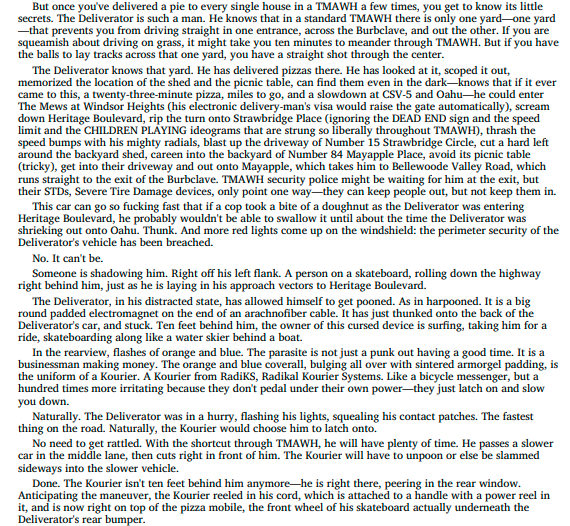
The plot moves rapidly between physical action, virtual exploration, corporate espionage, and linguistic mythology. Rather than following a linear narrative, the book constantly expands its world through exposition, digressions, and conceptual explanations.
While the structure may feel fragmented, it reflects the overwhelming complexity of the information age the novel seeks to portray.
The Metaverse: A Revolutionary Concept Ahead of Its Time
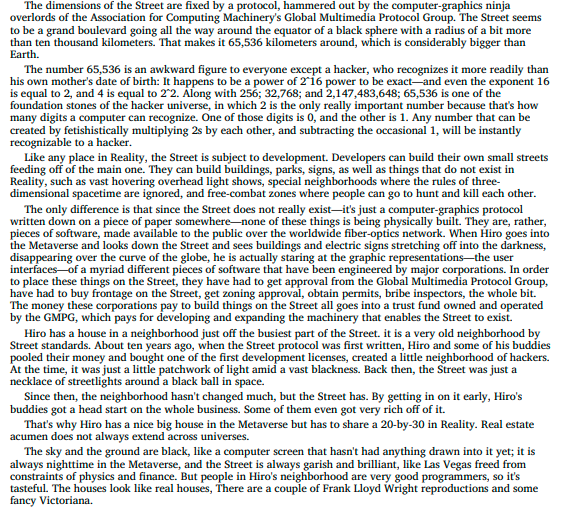
One of the most significant contributions of Snow Crash is its early and influential concept of the “Metaverse”—a shared virtual reality space where users interact through digital avatars.
This idea, introduced decades before modern virtual platforms, has had enormous cultural and technological influence. It anticipated elements of:
- Virtual reality environments
- Online gaming worlds
- Social digital spaces
- Immersive internet systems
The Metaverse in Snow Crash is not merely a technological invention; it is a parallel society. People escape physical reality and engage in identity construction, commerce, and communication inside digital environments.
However, Stephenson also presents the Metaverse as a place of inequality and corporate control. Access and status are often determined by wealth, technical ability, or corporate affiliation. This duality—liberation versus control—becomes one of the novel’s central tensions.
Hiro Protagonist: The Archetypal Cyberpunk Hero
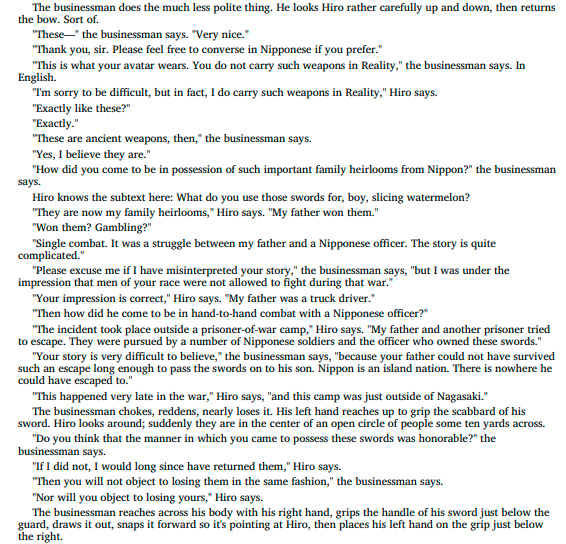
Hiro Protagonist (whose name itself is a playful linguistic joke) is a complex but stylized character. He embodies many classic cyberpunk traits:
- Highly skilled in hacking and combat
- Detached yet intellectually curious
- Operating on the margins of society
- Navigating both physical and virtual worlds
Hiro is not deeply emotional in a traditional literary sense. Instead, he functions as a conduit for ideas. His personality is defined more by competence and awareness than emotional development.
This approach may limit emotional depth for some readers, but it aligns with the novel’s broader emphasis on intellectual exploration over psychological realism.
Y.T.: Energy, Independence, and Social Commentary
Y.T. (short for “Yours Truly”) serves as a counterbalance to Hiro’s detached perspective. As a teenage skateboard courier navigating dangerous urban environments, she represents mobility, resilience, and youthful independence.
Her character adds grounded physicality to the otherwise abstract technological and philosophical discussions. She moves through real-world spaces filled with danger, corporate surveillance, and economic inequality.
Y.T. also reflects themes of autonomy and survival in a privatized society. Unlike traditional child characters in science fiction, she is resourceful and self-directed, often shaping events rather than simply reacting to them.
Themes: Language, Power, and Information as Control
1. Language as a Programmable System
One of the most intellectually ambitious aspects of Snow Crash is its theory of language. The novel suggests that language itself functions like a computer program capable of influencing human cognition.
The idea that ancient Sumerian language structures can act as a neurological virus forms the foundation of the story’s central conflict. This blending of linguistics and computing creates a unique conceptual framework where words become tools of control and infection.
2. Information Overload and Fragmentation
The novel reflects a world saturated with information. Characters constantly process data streams, advertisements, digital signals, and corporate messaging.
This overwhelming environment mirrors modern concerns about digital overload, making the book increasingly relevant in the age of social media and algorithmic content.
3. Corporate Feudalism
In Snow Crash, governments have largely failed or dissolved, replaced by corporate entities that function like independent nations. These corporations control infrastructure, law enforcement, and economic systems.
This structure creates a fragmented world where loyalty is not to a country but to an organization. It raises questions about sovereignty, identity, and economic inequality.
4. Mythology and Ancient Systems
Stephenson connects futuristic technology with ancient mythology, particularly Sumerian culture. This fusion suggests that modern systems of control are not entirely new but are rooted in ancient forms of linguistic and social programming.
This theme gives the novel a mythic dimension, transforming it from pure science fiction into a layered philosophical narrative.
Writing Style: Speed, Density, and Satirical Tone
Neal Stephenson’s writing style in Snow Crash is fast, dense, and highly energetic. The narrative frequently shifts between:
- Action sequences
- Technical explanations
- Cultural commentary
- Satirical observations
The tone is often humorous, ironic, and exaggerated. Stephenson uses satire to critique corporate culture, technology hype, and social fragmentation.
However, the density of information can be overwhelming. Long passages of exposition interrupt narrative flow, and readers may find themselves pausing frequently to process complex ideas.
This style is intentional—it mirrors the chaotic, overloaded information systems the novel describes.
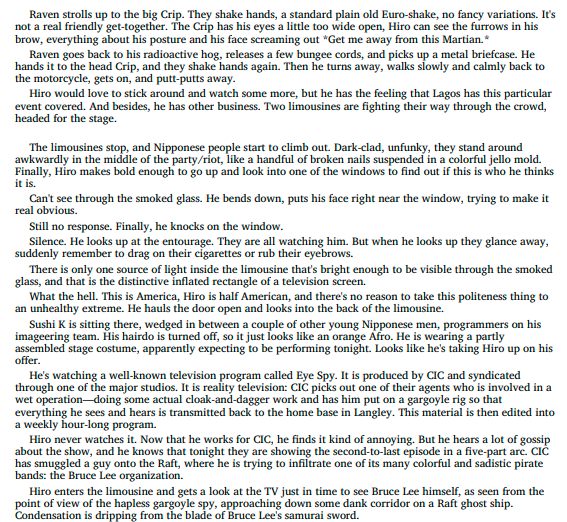
Worldbuilding: A Fragmented but Fascinating Future
The world of Snow Crash is one of its strongest elements. It is not a single unified society but a collection of competing systems:
- Corporate territories
- Independent zones
- Digital environments
- Criminal networks
Each region has its own rules, language, and structure. This fragmentation creates a sense of unpredictability and danger.
The world feels both exaggerated and plausible, especially in its depiction of privatized governance and digital dependence.
Strengths and Weaknesses
Strengths
- Highly original concept of the Metaverse
- Bold and imaginative worldbuilding
- Intellectual depth and interdisciplinary ideas
- Strong satirical critique of corporate society
- Influential impact on science fiction and technology discourse
Weaknesses
- Overloaded with exposition and technical digressions
- Limited emotional depth in some characters
- Fragmented narrative structure
- Occasional imbalance between story and ideas
Despite these limitations, the novel’s conceptual ambition often outweighs its structural imperfections.
Cultural and Technological Impact
Snow Crash has had a profound influence on both literature and technology. Its concept of the Metaverse has become especially significant in discussions about virtual reality and digital worlds.
Modern interpretations of immersive online environments owe much to Stephenson’s vision. The novel has also influenced:
- Game design
- Virtual reality development
- Cyberculture theory
- Internet architecture discussions
Its ideas continue to resonate in contemporary debates about digital identity and online existence.
Final Verdict: A Brilliant but Chaotic Vision of the Future
Snow Crash is not a conventional novel—it is an intellectual experiment disguised as a cyberpunk thriller. It challenges readers with rapid storytelling, dense concepts, and unconventional structure, but rewards them with one of the most imaginative depictions of the digital future ever written.
Neal Stephenson successfully creates a world where language, technology, mythology, and corporate power collide in unexpected ways. While the narrative can feel chaotic and overwhelming, that very chaos reflects the book’s central vision of an information-saturated world.
Ultimately, Snow Crash remains a landmark work in science fiction. It is a novel that is as influential as it is challenging—less a traditional story and more a blueprint for understanding how digital culture might evolve.
Available Formats
EPUB
Book Innformation In Point

Related posts:
 Womb City by Tlotlo Tsamaase PDF
 Neuromancer by William Gibson PDF Download
 Japanese Women Don’t Get Old or Fat by Naomi Moriyama PDF Download
 Gravity by Tess Gerritsen PDF Download
 Selling Out by Justina Robson PDF Download
 The Body Human by Nancy Kress PDF Download
 The Found and the Lost by Ursula K. Le Guin PDF Download
 Artemis by Andy Weir PDF Download
 Randomize by Andy Weir PDF Download
 Dark Matter by Blake Crouch PDF Download