
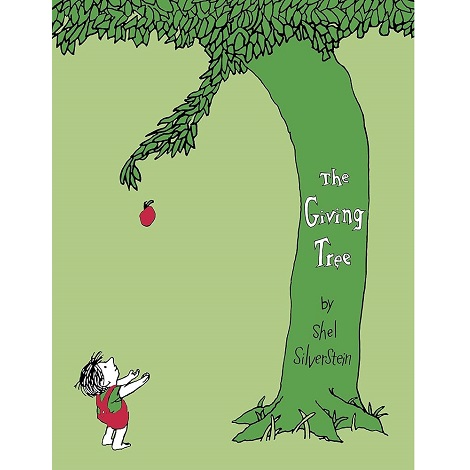
The Giving Tree by Shel Silverstein is one of the most widely recognized and emotionally debated children’s books ever published. Since its release in 1964, the book has remained both beloved and controversial, praised for its emotional simplicity while also criticized for the troubling dynamics embedded within its central relationship.
At first glance, The Giving Tree appears to be a straightforward story about unconditional love. The narrative follows the lifelong relationship between a boy and a tree who gives him everything she can throughout his life. However, beneath its minimalist language and childlike illustrations lies a far more complex emotional and philosophical work. The story raises difficult questions about generosity, self-sacrifice, emotional dependency, human selfishness, and the nature of love itself.
This review examines the book analytically and in a balanced manner, exploring why it continues to resonate with readers across generations while also provoking intense debate among educators, parents, and literary critics.
Narrative Simplicity and Structural Design
One of the most remarkable aspects of The Giving Tree is its simplicity. The story is told through short sentences, sparse dialogue, and uncomplicated illustrations. There are no elaborate descriptions, complex settings, or secondary plotlines. The structure is linear, following the boy from childhood to old age.
Yet this simplicity is highly deliberate. Shel Silverstein strips away distractions to focus entirely on the emotional dynamic between the two central figures: the boy and the tree. This minimalist structure allows readers to project their own interpretations and emotional experiences onto the story.
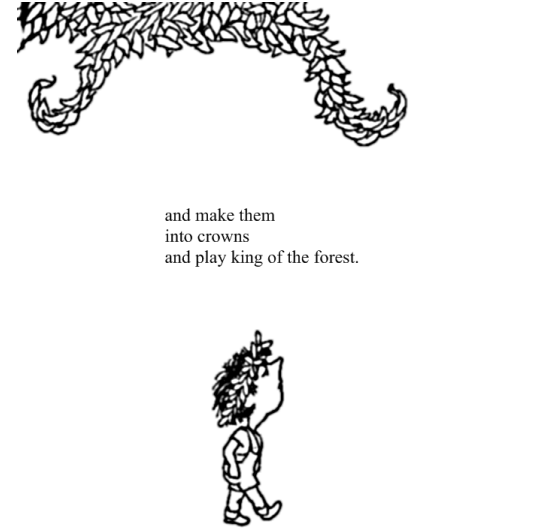
The pacing of the book also mirrors the progression of life itself. Childhood passes into adolescence, adulthood, middle age, and eventually old age. The transitions are subtle but emotionally effective, emphasizing the inevitability of change and the passage of time.
What makes the structure powerful is its emotional restraint. Silverstein never explicitly tells readers how to feel. Instead, the emotional impact emerges gradually through repetition and contrast.
The Tree as a Symbol of Unconditional Giving
The tree is the emotional center of the narrative. She gives the boy her apples, branches, trunk, and ultimately her remaining stump so that he can sit and rest. At every stage, her happiness is tied entirely to the boy’s happiness.
On one level, the tree symbolizes unconditional love. Many readers interpret her as representing:
- A parent’s love for a child
- Selfless friendship
- Maternal sacrifice
- Spiritual generosity
The tree never asks for anything in return except the boy’s presence. Her joy comes from giving.
This interpretation explains why the story resonates so deeply emotionally. The tree embodies an idealized form of love that expects no repayment and remains constant despite neglect.
However, this symbolism is also what makes the book controversial.
The Boy: Human Desire and Emotional Consumption
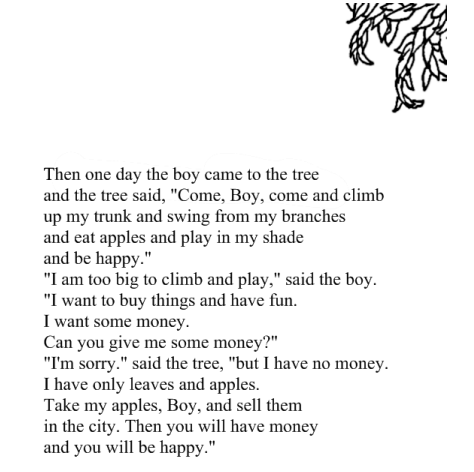
The boy undergoes a transformation throughout the narrative. As a child, he plays happily with the tree and enjoys her companionship. But as he grows older, his visits become increasingly transactional.
He no longer seeks emotional connection; instead, he approaches the tree only when he needs something:
- Money
- A house
- A boat
- A place to rest
The boy rarely expresses gratitude, and he repeatedly leaves after taking what he wants.
This progression can be interpreted in several ways.
One interpretation sees the boy as representing ordinary human behavior. Human beings often become consumed by ambition, material desires, and responsibilities as they age. The story may therefore function as a critique of how adulthood distances people from emotional simplicity and appreciation.
Another interpretation is far more critical: the boy represents selfishness and emotional exploitation. In this reading, the relationship becomes deeply unequal and unhealthy.
The ambiguity of the boy’s character is one of the reasons the book continues to generate debate decades after publication.
Themes: Love, Sacrifice, and Emotional Complexity
1. Unconditional Love
The most obvious theme is unconditional love. The tree gives endlessly without demanding reciprocity. Her love does not diminish even when the boy neglects her.
For many readers, this portrayal is profoundly moving because it reflects real experiences of parental or selfless love.
However, the novel complicates this theme by asking an implicit question: can unconditional love become self-destructive?
2. Selfishness and Human Consumption
The boy’s actions raise difficult moral questions. He takes continuously but rarely considers the tree’s well-being.
This dynamic can be interpreted as a broader commentary on human nature and consumption. Some readers see environmental symbolism in the story, viewing the tree as nature itself—generously providing resources while humanity takes endlessly without regard for sustainability.
This interpretation gives the book ecological relevance beyond its emotional narrative.
3. Aging and the Passage of Time
The book quietly explores aging and mortality. Both characters change physically and emotionally over time.
The boy ages into an exhausted old man, while the tree gradually diminishes physically through her sacrifices. By the end, neither resembles their earlier selves.
The emotional effect of this progression is powerful because it reflects the inevitability of loss and transformation within life itself.
4. Happiness and Fulfillment
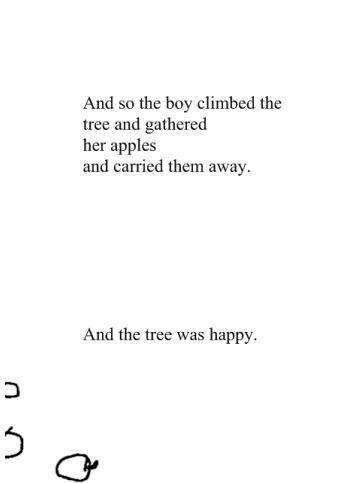
A repeated line throughout the book states that “the tree was happy.” Yet readers are left to question whether this happiness is genuine fulfillment or emotional dependency.
This ambiguity is central to the book’s enduring complexity. Silverstein intentionally avoids resolving the moral tension.
Writing Style: Minimalism With Emotional Precision
Shel Silverstein’s writing style is deceptively simple. The vocabulary is accessible enough for young readers, but the emotional implications are sophisticated.
The sparse prose allows silence and repetition to carry meaning. Because the language is restrained, readers focus intensely on the emotional interactions.
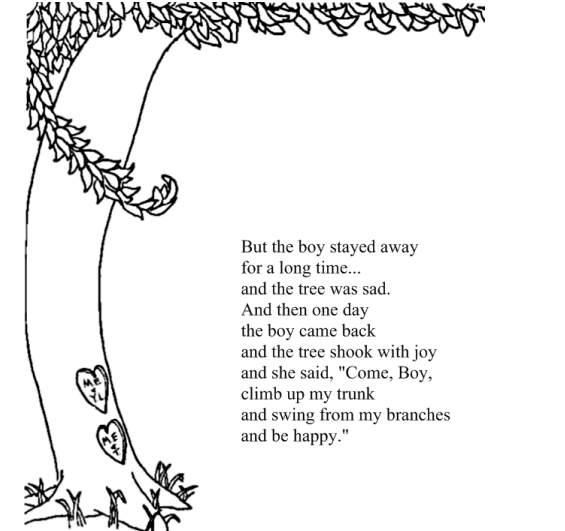
The illustrations contribute significantly to this effect. Silverstein’s black-and-white drawings appear almost childlike, reinforcing the book’s simplicity while also creating emotional intimacy.
Unlike heavily descriptive children’s books, The Giving Tree leaves interpretive space for readers. This openness is one reason adults and children often experience the story very differently.
Emotional Impact Across Different Ages
One of the book’s most fascinating qualities is how differently it affects readers depending on age and perspective.
Children’s Perspective
Young children often see the story primarily as one of love and kindness. They focus on the warmth of the relationship and the comforting presence of the tree.
Adult Perspective
Adults frequently experience the story with greater emotional ambiguity. Many readers identify with the exhaustion of the tree or recognize unhealthy patterns of emotional sacrifice.
This duality allows the book to function on multiple levels simultaneously.
Criticism and Controversy
While The Giving Tree is beloved by millions, it has also faced significant criticism.
Some critics argue that the book romanticizes unhealthy self-sacrifice and emotional imbalance. They contend that the tree’s endless giving encourages the idea that love requires complete self-erasure.
Others criticize the boy’s behavior and question why the narrative never explicitly challenges his selfishness.
Feminist critics have also analyzed the relationship through the lens of gender dynamics, arguing that the tree represents stereotypical expectations of maternal self-sacrifice.
These criticisms are important because they highlight the book’s complexity rather than diminishing it. The fact that the story can sustain such varied interpretations demonstrates its literary depth.
Why the Book Endures
Despite the debates surrounding it, The Giving Tree remains culturally significant because it touches universal emotional experiences:
- The desire to love and be loved
- The pain of growing apart
- The tension between giving and losing oneself
- The passage of time
The story’s emotional openness allows readers to interpret it according to their own experiences and beliefs.
Some view it as beautiful and compassionate. Others find it tragic and unsettling. Both responses are valid, and the coexistence of these interpretations is part of the book’s lasting power.
Educational and Psychological Value
From an educational standpoint, The Giving Tree is valuable because it encourages discussion rather than offering simplistic moral lessons.
Teachers and parents often use the book to explore:
- Gratitude
- Empathy
- Healthy relationships
- Environmental awareness
- Emotional boundaries
Its simplicity makes it accessible to children, while its ambiguity creates opportunities for deeper conversation with older readers.
Psychologically, the book also helps readers examine the balance between generosity and self-care.
Literary Significance in Children’s Literature
The Giving Tree occupies a unique place in children’s literature because it refuses to conform entirely to comforting conventions.
Many children’s books present clear moral structures and emotionally reassuring endings. The Giving Tree instead leaves readers with unresolved emotional tension.
This refusal to simplify human relationships gives the book unusual literary sophistication for a picture book.
Shel Silverstein trusted readers to grapple with ambiguity—a quality that has helped the book remain relevant across generations.
Strengths and Weaknesses
Strengths
- Emotionally powerful simplicity
- Rich symbolic interpretation
- Universal themes
- Accessible language with philosophical depth
- Strong emotional resonance across age groups
Weaknesses
- Ambiguous moral framework may trouble some readers
- Relationship dynamic can feel emotionally unhealthy
- Limited character complexity beyond symbolic roles
These weaknesses are inseparable from the book’s strengths. The ambiguity that unsettles some readers is also what gives the story lasting interpretive depth.
Final Verdict: A Children’s Classic That Invites Debate
The Giving Tree remains one of the most emotionally and philosophically complex picture books ever written. Beneath its gentle language and minimalist illustrations lies a challenging exploration of love, sacrifice, aging, selfishness, and emotional dependency.
Shel Silverstein created a story that resists easy interpretation. Some readers experience it as a celebration of unconditional love, while others see it as a cautionary tale about imbalance and self-destruction.
The brilliance of the book lies in its ability to sustain both interpretations simultaneously.
Whether viewed as heartwarming or heartbreaking, The Giving Tree continues to provoke reflection because it addresses emotional truths that remain deeply human. It is not merely a children’s story—it is a literary work that challenges readers to consider what it truly means to give, to love, and to grow older.
Available Formats
EPUB
Book Innformation In Point
- Author: Shel Silverstein
- Genre: Children’s literature / Picture book Children’s Christmas Books Children’s Beginner Readers Children’s Classics
- Published: 1964
- Publisher: Harper & Row
- Main Characters: The Boy, The Tree
- Setting: A simple natural environment (tree and surrounding space)
- Themes:
- Unconditional love
- Sacrifice and generosity
- Human selfishness
- Aging and life cycle
- Emotional dependency
- Writing Style:
- Very simple and minimal text
- Symbolic storytelling
- Emotional and reflective tone
- Black-and-white illustrations
- Literary Importance:
- One of the most famous children’s books ever written
- Widely studied and debated for its moral meaning
- Appeals to both children and adults
- Overall Idea:
A symbolic story about a tree that gives everything to a boy, exploring complex emotions around love, giving, and human relationships.
Download Method The Giving Tree by Shel Silverstein
By Clicking on the below download button, you will initiate the downloading process of The Giving Tree by Shel Silverstein.The book is available in both ePub and PDF format with a single click, moreover we offer unlimited books for downloading without any spams, bombardment of ads. Flyers and needless links. Your support in regard to sharing with friends, family members, colleagues are always welcome. Do not forget to share your ideas and thoughts in the comment section.
You may also like
Neuromancer by William Gibson PDF Download
Charlotte’s Web by Garth Williams PDF Download
Henry and Mudge and the Great Grandpas by Cynthia Rylant PDF Download
The Hello, Goodbye Window by Norton Juster PDF Download

EPUB
Related posts:
 Nic Blake and the Remarkables by Angie Thomas PDF Download
 Fall of the School for Good and Evil by Soman Chainani PDF Download
 Chasing Pacquiao by Rod Pulido PDF Download
 Where The River Takes Us by Lesley Parr PDF Download
 Boomi’s Boombox by Shanthi Sekaran PDF Download
 In the Tunnel by Julie Lee PDF Download
 Little Bigfoot, Big City by Jennifer Weiner PDF Download
 Grounded by Aisha Saeed PDF Download
 Ruby Lost and Found by Christina Li PDF Download
 You Were Always Mine by Christine Pride & Jo Piazza PDF Download