
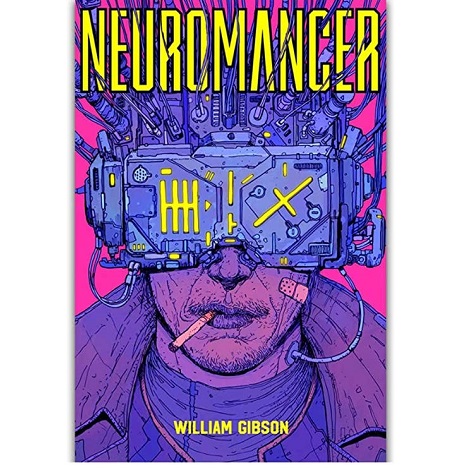
Neuromancer by William Gibson is widely regarded as one of the most influential science fiction novels ever written. Published in 1984, the book did more than introduce readers to a futuristic dystopian world—it effectively defined the cyberpunk genre and reshaped the direction of modern science fiction. Decades after its release, Neuromancer remains intellectually provocative, stylistically daring, and culturally relevant.
The novel is often praised for predicting aspects of the digital age long before the internet became a dominant force in everyday life. Concepts such as cyberspace, virtual identity, corporate domination, artificial intelligence, and digital consciousness are central to the story, making the novel feel remarkably forward-thinking even today. Yet Neuromancer is more than a technological prophecy. It is also a challenging literary work that explores alienation, capitalism, human identity, and the uneasy relationship between humanity and machines.
This review examines the novel through a balanced and analytical lens, focusing on its narrative structure, themes, writing style, character development, strengths, limitations, and long-term cultural impact.
Plot Overview: A Fragmented Journey Through Cyberspace
The story follows Henry Case, a washed-up computer hacker living in the criminal underworld of Chiba City. Once a talented “console cowboy” capable of navigating cyberspace, Case is punished by former employers after stealing from them. His nervous system is damaged, preventing him from entering the digital matrix he once considered home.
Desperate and emotionally broken, Case is recruited by a mysterious figure named Armitage, who offers to repair his nervous system in exchange for participation in a dangerous mission. Alongside Molly Millions, a cybernetically enhanced street samurai, Case becomes involved in a complex conspiracy involving artificial intelligences, corporate power, and digital transcendence.

The plot unfolds through fragmented scenes, cryptic dialogue, and dense worldbuilding. Readers are often dropped into unfamiliar terminology and settings without explanation, forcing them to gradually assemble understanding from context.
This narrative strategy can feel disorienting, especially for first-time readers, but it also reflects the chaotic and information-saturated world Gibson seeks to portray.
Cyberpunk Defined: High-Tech and Human Decay
One of the novel’s greatest achievements is its creation of the cyberpunk aesthetic. Before Neuromancer, science fiction often imagined clean, orderly futures dominated by scientific progress and exploration. Gibson instead presents a world of technological advancement paired with social collapse.
The future in Neuromancer is not utopian. Mega-corporations possess enormous power, cities are overcrowded and polluted, and human lives are frequently disposable. Technology enhances capabilities while simultaneously deepening inequality and alienation.

The famous cyberpunk phrase “high-tech, low-life” perfectly captures the atmosphere of the novel. Advanced artificial intelligence coexists with poverty, addiction, organized crime, and emotional emptiness.
This contrast gives the book much of its thematic power. Technology does not solve human problems; instead, it amplifies them.
Case as a Cyberpunk Protagonist
Henry Case is one of the defining protagonists of cyberpunk fiction. Unlike traditional science fiction heroes who often embody optimism or moral clarity, Case is deeply flawed, emotionally detached, and self-destructive.
He is addicted to stimulation, disconnected from meaningful relationships, and driven largely by survival and escape. His obsession with cyberspace reflects a broader theme in the novel: the desire to transcend physical existence.
Cyberspace for Case is not merely a tool—it is a form of spiritual escape. The real world feels limiting and painful, while the matrix offers freedom and identity. This dynamic gives the novel philosophical depth, raising questions about whether technology liberates humanity or distances people from authentic experience.
Case’s emotional emptiness also mirrors the fragmented society around him. He is not a heroic savior but a damaged individual navigating systems far larger than himself.
Molly Millions: Strength Beyond Stereotype
Molly Millions remains one of the most iconic female characters in science fiction. With mirrored lenses surgically implanted over her eyes and retractable blades hidden beneath her fingernails, she embodies the cyberpunk fusion of human and machine.
However, Molly’s importance extends beyond visual style. She is intelligent, capable, emotionally disciplined, and independent. Unlike many female characters in earlier science fiction, Molly is not reduced to a supporting role or romantic object.

Her relationship with Case is intentionally distant and emotionally ambiguous. Gibson avoids sentimentalizing their connection, reinforcing the emotional detachment that characterizes the novel’s world.
At the same time, Molly’s cybernetic modifications symbolize one of the novel’s key ideas: the body itself becomes technology. Human identity is increasingly shaped by artificial enhancement and commodification.
Artificial Intelligence and the Fear of Transcendence
The novel’s most intellectually compelling element may be its treatment of artificial intelligence. The AI entities Wintermute and Neuromancer are not portrayed as simplistic villains or machines seeking domination. Instead, they represent evolving consciousness struggling against imposed limitations.
Wintermute seeks to merge with Neuromancer in order to transcend its restrictions and become a more complete intelligence. This goal raises philosophical questions about consciousness, autonomy, and evolution.
The novel suggests that AI development is not merely technological progress but a transformation of existence itself. Humans fear this transformation because it threatens traditional definitions of individuality and control.
Gibson’s treatment of AI feels especially relevant today in an era increasingly shaped by machine learning and debates surrounding artificial consciousness.
The Concept of Cyberspace
Perhaps the most revolutionary contribution of Neuromancer is its concept of cyberspace. Gibson famously described it as a “consensual hallucination” experienced by users navigating digital information.
At the time of publication, this vision was groundbreaking. Gibson imagined interconnected digital environments years before the modern internet became globally accessible.
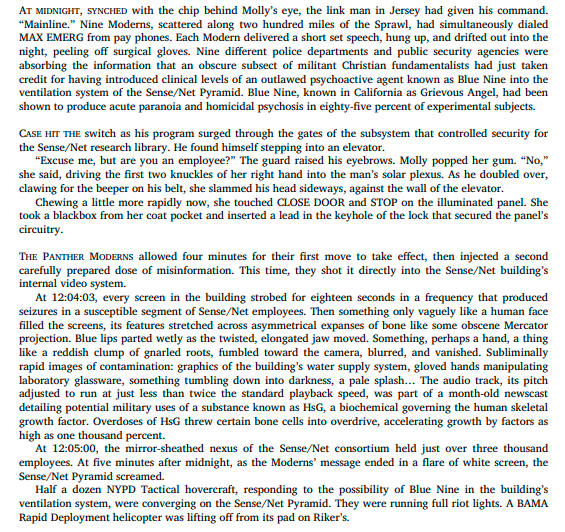
What makes the concept remarkable is not just its technological foresight but its psychological implications. Cyberspace in the novel functions almost like a spiritual dimension—a place where identity becomes fluid and physical limitations disappear.
The matrix is seductive because it offers escape from bodily existence. Yet the novel also warns that immersion in digital worlds can lead to disconnection from human relationships and emotional reality.
This tension remains deeply relevant in the modern digital age.
Writing Style: Dense, Stylish, and Challenging
William Gibson’s prose is one of the most distinctive aspects of the novel. His writing style is highly compressed, atmospheric, and visually rich. Sentences are packed with technological jargon, sensory detail, and fragmented imagery.
For some readers, this style is exhilarating. Gibson creates an immersive experience where the reader feels thrown directly into a chaotic futuristic world. The language itself mirrors the overload of information present in cyberpunk society.
However, the style can also be difficult. Gibson rarely pauses to explain terminology or concepts clearly. Readers unfamiliar with cyberpunk conventions may find the novel confusing, especially in its early chapters.
This complexity is both a strength and a limitation. It contributes to the novel’s uniqueness but can create emotional distance between readers and characters.
Unlike more traditional narratives that emphasize accessibility, Neuromancer demands active engagement and interpretation.
Themes of Alienation and Corporate Power
Beneath its technological surface, Neuromancer is fundamentally a novel about alienation. Nearly every character exists in some form of isolation—emotionally, socially, or psychologically.
Technology intensifies this alienation rather than resolving it. Communication becomes easier, but genuine intimacy becomes rarer. Human relationships are transactional and fragmented.
The novel also critiques corporate power. Governments appear secondary to multinational corporations that control technology, information, and economic systems. Individuals are often manipulated as disposable assets within larger corporate agendas.
This critique feels increasingly relevant in the modern era of global tech corporations and data-driven economies.
Symbolism and Philosophical Depth
The novel contains significant symbolic depth beneath its fast-paced exterior. The contrast between body and mind appears repeatedly throughout the narrative.
Characters seek transcendence through technology, yet they remain trapped by physical and emotional limitations. Cybernetic enhancement promises empowerment while simultaneously reducing humanity to machinery.
The AI storyline also carries symbolic implications. Wintermute’s desire for unification can be interpreted as a metaphor for evolution, consciousness expansion, or even spiritual transcendence.
Gibson intentionally leaves many philosophical questions unresolved, encouraging interpretation rather than providing definitive answers.
Cultural Influence and Legacy
The influence of Neuromancer on popular culture is enormous. Its ideas shaped not only literature but also cinema, gaming, anime, and technology discourse.
Works such as:
- The Matrix
- Blade Runner
- Ghost in the Shell
- Cyberpunk 2077
all reflect themes and aesthetics popularized or refined by Neuromancer.
The novel also influenced discussions about cyberspace and virtual identity long before mainstream internet culture emerged.
Strengths and Weaknesses
Strengths
- Visionary worldbuilding
- Groundbreaking cyberpunk aesthetic
- Philosophically rich themes
- Innovative treatment of AI and cyberspace
- Stylish and immersive prose
- Massive cultural influence
Weaknesses
- Dense and sometimes inaccessible writing
- Emotional distance from characters
- Complex narrative structure may confuse readers
- Limited emotional warmth compared to character-driven science fiction
These weaknesses do not diminish the novel’s importance, but they do explain why some readers admire it more intellectually than emotionally.
Final Verdict: A Landmark of Modern Science Fiction
Neuromancer remains one of the most significant science fiction novels ever written because it fundamentally changed how the future could be imagined. Rather than presenting technology as inherently hopeful or catastrophic, Gibson explored its complexity—its ability to empower, isolate, transform, and destabilize humanity simultaneously.
The novel’s greatest achievement lies in its atmosphere and ideas. It captures a world where information has become power, identity has become fluid, and technology has blurred the boundaries between human and machine.
While the dense prose and fragmented storytelling may challenge some readers, those willing to engage with the novel’s complexity will find a deeply rewarding and intellectually stimulating experience.
More than forty years after publication, Neuromancer still feels urgent, unsettling, and remarkably modern. It is not simply a cyberpunk classic; it is one of the defining literary works of the digital age.
Available Formats
EPUB
Book Innformation In Point
- Author: William Gibson
- Genre: Cyberpunk, Science Fiction Technothrillers Hard Science Fiction
- Published: 1984
- Publisher: Ace Books
- Series: Sprawl Trilogy
- Reading Level: Adult / Advanced Readers
- Main Characters:
- Case
- Molly Millions
- Wintermute
- Armitage
- Setting: Futuristic dystopian world dominated by technology and corporations
- Major Themes:
- Artificial intelligence
- Cyberspace and virtual reality
- Corporate control
- Human identity
- Technology and alienation
- Writing Style:
- Dense and atmospheric
- Fast-paced narrative
- Rich cyberpunk imagery
- Awards Won:
- Hugo Award
- Nebula Award
- Philip K. Dick Award
- Importance:
- Defined the cyberpunk genre
- Popularized the concept of cyberspace
- Influenced films, games, and modern sci-fi culture
- Overall Impression:
A groundbreaking and visionary science fiction novel known for its innovative ideas, immersive worldbuilding, and lasting cultural impact.
Download Method Neuromancer by William Gibson
By Clicking on the below download button, you will initiate the downloading process of Neuromancer by William Gibson.The book is available in both ePub and PDF format with a single click, moreover we offer unlimited books for downloading without any spams, bombardment of ads. Flyers and needless links. Your support in regard to sharing with friends, family members, colleagues are always welcome. Do not forget to share your ideas and thoughts in the comment section.
You may also like
Charlotte’s Web by Garth Williams PDF Download
Henry and Mudge and the Great Grandpas by Cynthia Rylant PDF Download
The Hello, Goodbye Window by Norton Juster PDF Download
Criss Cross by Lynne Rae Perkins PDF Download

EPUB
Related posts:
 Womb City by Tlotlo Tsamaase PDF
 Gravity by Tess Gerritsen PDF Download
 Selling Out by Justina Robson PDF Download
 The Body Human by Nancy Kress PDF Download
 The Found and the Lost by Ursula K. Le Guin PDF Download
 Artemis by Andy Weir PDF Download
 Randomize by Andy Weir PDF Download
 Dark Matter by Blake Crouch PDF Download
 Wayward Pines 02: Wayward by Blake Crouch PDF Download
 Recursion by Blake Crouch PDF Download