
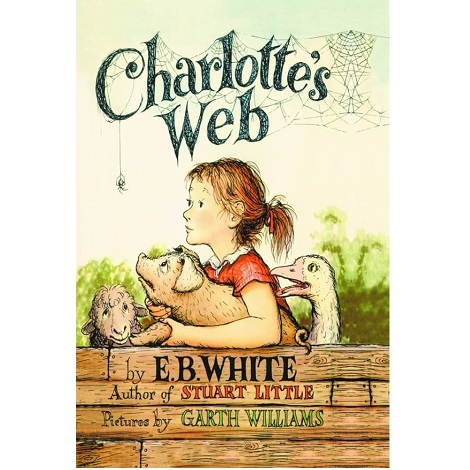
Charlotte’s Web is one of the most enduring works in children’s literature, illustrated by Garth Williams and written by E. B. White. While often introduced as a simple children’s story about a pig and a spider, the novel is far more layered than its surface suggests. It is a carefully constructed meditation on life, death, loyalty, and the quiet forms of love that shape moral understanding.
This review takes a structured and analytical approach to the book, examining its narrative design, thematic depth, character development, symbolism, and emotional impact. Rather than treating it solely as a sentimental childhood favorite, it evaluates the novel as a literary work that continues to resonate across generations.
Narrative Structure: Simplicity With Purpose
At first glance, Charlotte’s Web follows a straightforward linear structure. The story begins with the rescue of Wilbur, a runt pig, and follows his journey on the Zuckerman farm, where he learns of his eventual fate. The plot progresses through seasonal changes, culminating in the emotional climax at the county fair.
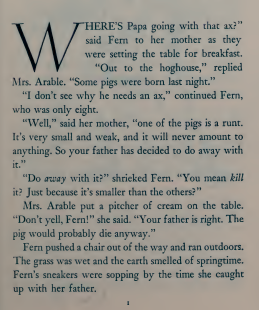
However, beneath this simplicity lies a carefully balanced structure. Each section of the narrative corresponds to a stage in Wilbur’s emotional development: fear, friendship, hope, and acceptance. The pacing is deliberate, allowing readers—especially younger ones—to process complex emotional ideas gradually.
E. B. White avoids unnecessary subplots. Instead, every scene reinforces the central themes. The barn becomes a microcosm of life itself, where animals represent different perspectives on survival, intelligence, and meaning.
Character Analysis: More Than Anthropomorphic Figures
Wilbur: Innocence and Dependence
Wilbur is not merely a talking pig; he represents innocence confronted with mortality. His fear of death is immediate and relatable, even for adult readers. Unlike heroic protagonists, Wilbur’s strength lies in his vulnerability. He does not overcome fate through force but through connection and acceptance of help from others.
His emotional development is subtle. At the beginning, he is entirely dependent on Fern’s care. By the end, he has developed emotional resilience, though not through independence in the traditional sense, but through trust in friendship.
Charlotte: Intelligence and Self-Sacrifice
Charlotte, the spider, is arguably the novel’s moral center. She represents intelligence guided by compassion. Her actions are deliberate, strategic, and selfless. Unlike many literary mentors, she does not merely guide Wilbur—she actively reshapes his fate.
Her web-writing is both literal and symbolic. Each word she spins—“Some Pig,” “Terrific,” “Radiant,” and finally “Humble”—is carefully chosen to manipulate human perception. Yet her manipulation is ethical, driven by a desire to save Wilbur’s life.
Charlotte’s greatest complexity lies in her acceptance of death. Unlike Wilbur, she understands mortality and does not resist it. Her character introduces young readers to the idea that a meaningful life is not defined by longevity but by impact.
Fern: The Human Bridge
Fern serves as the emotional bridge between human and animal worlds. Her early insistence that Wilbur deserves life introduces the novel’s moral question: what makes a life valuable? However, as the story progresses, Fern gradually steps back, symbolizing the transition from childhood innocence to adult detachment.
Her role diminishes not because she is unimportant, but because the narrative shifts toward Wilbur’s internal world and Charlotte’s influence.
Themes: Depth Beneath Simplicity
1. Friendship as Moral Action
The central theme of Charlotte’s Web is friendship, but not in a superficial sense. Friendship here is portrayed as action, sacrifice, and responsibility. Charlotte does not simply comfort Wilbur; she actively intervenes in his fate.
This elevates friendship from emotional connection to ethical commitment.
2. Mortality and Acceptance
One of the most striking aspects of the novel is its direct engagement with death. Unlike many children’s books, it does not avoid the subject. Instead, it integrates mortality into the fabric of life on the farm.
Charlotte’s death is not sensationalized. It is quiet, natural, and inevitable. The contrast between her calm acceptance and Wilbur’s grief highlights the novel’s philosophical stance: death is part of life, but meaning persists through memory and legacy.
3. The Power of Language
Charlotte’s ability to weave words into her web introduces a powerful commentary on language itself. Words shape perception. The humans in the story are influenced not by Wilbur’s actual condition but by the messages they read.
This raises questions about persuasion, belief, and truth. Language becomes a tool of survival, demonstrating how meaning is socially constructed.
4. Cycles of Life and Continuity
The seasonal structure of the novel reinforces the theme of life cycles. Birth, growth, decline, and renewal are all present. Charlotte’s children at the end of the story symbolize continuity rather than closure.
The novel does not end with loss alone; it ends with transformation.
Symbolism: The Barn as a Microcosm
The barn in Charlotte’s Web functions as a symbolic universe. It is both a physical space and a representation of society. Inside it, different animals represent different philosophies of life:
- Wilbur: innocence and dependence
- Charlotte: intelligence and sacrifice
- Templeton the rat: self-interest and survival instinct
- The sheep and geese: communal voice and commentary
This microcosm allows the novel to explore ethical questions without abstraction. Every interaction reflects a broader philosophical idea.
Charlotte’s web itself is the most significant symbol. It represents creation, communication, and transformation. It is both fragile and powerful—like life itself.
Writing Style: Clarity With Emotional Precision
E. B. White’s writing style is deceptively simple. The sentences are clean, accessible, and often understated. However, this simplicity is what gives the novel its emotional precision.
There is no excessive description or rhetorical flourish. Instead, meaning emerges through dialogue, action, and timing. This restraint allows emotional moments—such as Charlotte’s final goodbye—to carry greater weight.
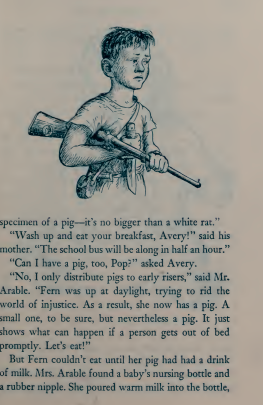
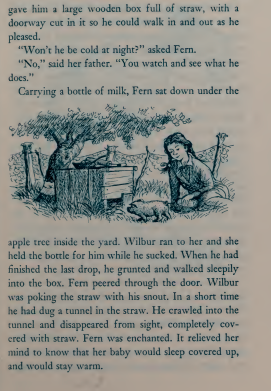
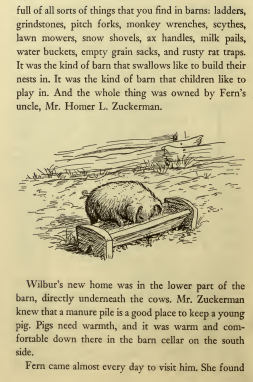
Garth Williams’ illustrations complement this style by reinforcing emotional clarity without overwhelming the text. The visual tone remains soft and expressive, enhancing the reader’s emotional engagement.
Emotional Impact: A Carefully Controlled Sentiment
One of the most debated aspects of Charlotte’s Web is its emotional effect on readers. Many describe it as heartbreaking, especially Charlotte’s death. However, the novel’s emotional strategy is more complex than simple sadness.
It balances grief with gratitude. Charlotte’s absence is deeply felt, but it is framed within a larger narrative of continuity and memory. Wilbur’s survival, along with Charlotte’s children, prevents the story from becoming purely tragic.
This emotional balance is what makes the book enduring rather than overwhelming.
Educational and Psychological Value
From an educational perspective, Charlotte’s Web is often used to introduce children to complex emotional and ethical concepts. These include:
- Understanding death in a natural context
- Recognizing the value of empathy
- Learning about loyalty and sacrifice
- Developing emotional literacy
Psychologically, the book helps young readers process fear and loss in a safe narrative environment. It does not shield them from difficult truths but presents them gently and thoughtfully.
Critical Evaluation: Strengths and Limitations
Strengths
- Deep thematic richness within a simple structure
- Memorable and emotionally complex characters
- Balanced emotional tone
- Strong symbolic framework
- Universal appeal across age groups
Limitations
- Some secondary characters lack development
- Templeton’s role, while interesting, is underexplored
- The simplicity of language may feel minimal to advanced readers seeking complexity in style
Despite these minor limitations, the novel’s strengths far outweigh its weaknesses.
Final Verdict: A Quiet Masterpiece of Children’s Literature
Charlotte’s Web remains a cornerstone of children’s literature because it respects its readers. It does not simplify life’s hardest truths, nor does it dramatize them unnecessarily. Instead, it presents them with clarity, compassion, and restraint.
The collaboration between E. B. White and illustrator Garth Williams results in a work that is emotionally resonant, intellectually layered, and thematically timeless.
Ultimately, the novel’s greatest achievement is its honesty. It acknowledges that life is temporary, relationships are precious, and meaning is created through connection and care. For readers of all ages, Charlotte’s Web is not just a story—it is a quiet lesson in how to live and how to let go.
Available Formats
EPUB
Book Innformation In Point
- Title: Charlotte’s Web
- Author: E. B. White
- Illustrator: Garth Williams
- Genre: Children’s Literature / Fantasy / Realistic Fiction
- First Published: 1952
- Reading Level: Middle Grade / Children’s Classic
Download Method Charlotte’s Web by Garth Williams.
By Clicking on the below download button, you will initiate the downloading process of Charlotte’s Web by Garth Williams..The book is available in both ePub and PDF format with a single click, moreover we offer unlimited books for downloading without any spams, bombardment of ads. Flyers and needless links. Your support in regard to sharing with friends, family members, colleagues are always welcome. Do not forget to share your ideas and thoughts in the comment section.
You may also like
Henry and Mudge and the Great Grandpas by Cynthia Rylant PDF Download
The Hello, Goodbye Window by Norton Juster PDF Download
Criss Cross by Lynne Rae Perkins PDF Download
Looking for Alaska by John Green Free Download

Related posts:
 The House at the Edge of Magic by Amy Sparkes PDF Download
 Nic Blake and the Remarkables by Angie Thomas PDF Download
 Fall of the School for Good and Evil by Soman Chainani PDF Download
 Chasing Pacquiao by Rod Pulido PDF Download
 Where The River Takes Us by Lesley Parr PDF Download
 Boomi’s Boombox by Shanthi Sekaran PDF Download
 In the Tunnel by Julie Lee PDF Download
 Little Bigfoot, Big City by Jennifer Weiner PDF Download
 Grounded by Aisha Saeed PDF Download
 Code Red by Joy McCullough PDF Download