
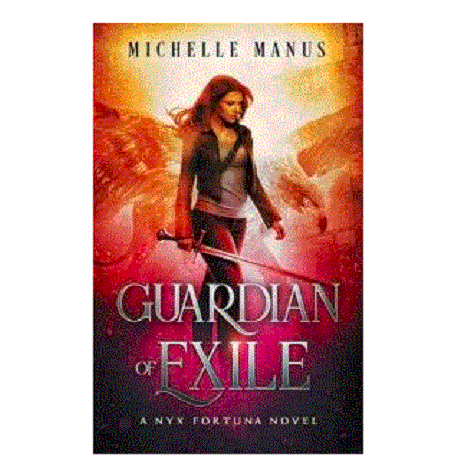
Michelle Manus returns to the world of Nyx Fortuna with Guardian of Exile, the seventh novel in the Nyx Fortuna series. Published by Seclusion Publishing on August 11, 2026, the novel continues a long-running urban-fantasy saga that began with Guardian of Chaos in 2021 and has since expanded through Guardian of Shadows, Guardian of Madness, Guardian of Torment, Guardian of Defiance, and Guardian of Wrath.
For readers who have followed Nyx Fortuna from the beginning, Guardian of Exile offers another chapter in a world where supernatural danger, personal resilience, and questions of hope are closely connected. For newer readers, however, this is unmistakably a book from an established series rather than an ideal standalone entry point. The story assumes that readers are interested in continuing Nyx’s larger journey and are willing to step into a fictional universe that already has considerable history behind it.
What makes Guardian of Exile particularly intriguing is its emotional premise. Nyx is trying to readjust to normal life at the Station, but normality does not come easily. Her next problem gives her little opportunity to settle: she needs to find Tristen Veld, an exiled Shaman whose help may be the key to freeing Griff and the Stations. The search takes Nyx toward Dead Earth and toward a man who has been shaped by fifteen difficult years.
On paper, that sounds like another supernatural mission.
Underneath it, however, is something more personal.
The story is also about people who have been damaged by their circumstances and about whether someone who has lost faith in the future can be persuaded to fight for it again.
That gives Guardian of Exile an emotional foundation that reaches beyond the fantasy adventure.
Returning to Nyx Fortuna’s World
The first thing to appreciate about Guardian of Exile is the amount of history behind it.
The Nyx Fortuna series has been developing since 2021, with each installment carrying its own title and continuing the broader journey. Guardian of Exile is officially listed as Book 7, following Guardian of Wrath, which was released in 2025.
Seven books into a series, the fictional world is no longer simply a backdrop.
It has become part of the reading experience.
Readers who have already spent time with Nyx understand that returning to this series means returning to an established mythology, familiar conflicts, and a protagonist whose experiences have shaped her considerably.
That history gives Guardian of Exile an advantage that a standalone fantasy novel does not have. Manus does not have to build Nyx from nothing. Instead, she can focus on where Nyx is now and what the next challenge reveals about her.
The title itself is also significant.
“Exile” immediately suggests separation, rejection, isolation, and the feeling of existing outside a place where one should belong.
Those ideas are central to the novel’s premise because Tristen Veld is an exiled Shaman. His exile is not simply a piece of fantasy-world terminology; it appears to have profoundly affected his personality. The official synopsis describes him as cynical and angry after fifteen years in Dead Earth, suggesting that his circumstances have changed not only where he lives but also how he sees the world.
Nyx Is Searching for More Than a Man
The main plot begins with a practical objective: Nyx needs to locate Tristen Veld.
But the more interesting part of the premise is what happens after she finds him.
Tristen is not the helpful magical expert Nyx might have imagined. Instead, she discovers someone who has been profoundly affected by his years of exile.
That creates an immediate complication.
Finding someone and convincing them to help are two very different things.
This distinction gives Nyx’s mission emotional weight. She cannot simply locate Tristen, explain the situation, and expect him to join the fight. She has to deal with his cynicism, anger, and apparent loss of hope.
The official description makes this conflict particularly clear: Nyx is uncertain that she is the right person to convince Tristen to help, but she knows that she has to try.
That is an appealing setup because it puts character interaction at the center of the fantasy plot.
The supernatural problem may be what sends Nyx on the journey, but the emotional problem is what makes the journey interesting.
Tristen Veld Is the Book’s Most Intriguing Element
Tristen is arguably the most compelling element of the premise.
An exiled Shaman who has spent fifteen years in Dead Earth has already experienced enough separation and hardship to make the reader wonder what happened to him.
What does fifteen years of exile do to a person?
What happens when someone who once had a role, a community, or a sense of purpose is removed from all of it?
And what would it take to convince that person that returning to the fight is worthwhile?
These questions give Tristen immediate dramatic potential.
He is not simply another supernatural character with special abilities. His emotional state appears to be inseparable from his history.
That is a strength.
Fantasy characters are most memorable when their supernatural identities and their emotional identities influence each other. A Shaman who has become cynical after years of exile is more interesting than a Shaman whose only function is to provide magical information.
Tristen brings conflict into the story before the larger external conflict even begins.
The Central Theme: Hope After Exile
The most meaningful idea in Guardian of Exile is arguably its treatment of hope.
The publisher description ends with an especially revealing premise: Nyx’s attempt to convince someone else that life is worth fighting for may lead her to convince herself of the same thing.
That is a strong thematic foundation.
It means the story’s emotional journey potentially works in two directions.
Nyx believes she needs to change Tristen’s outlook.
But Tristen may also force Nyx to confront her own doubts.
That kind of mirrored character development can make fantasy stories much more satisfying. The external quest provides movement, while the internal questions provide meaning.
It also makes the title more resonant.
Exile is not necessarily only about being physically removed from a place. It can also describe emotional exile: feeling disconnected from hope, community, purpose, or even one’s former identity.
Tristen’s exile is literal.
Nyx’s struggles appear to be more internal.
Putting the two together creates an opportunity for the story to explore different forms of isolation.
Why the Station Matters
Another intriguing aspect of the setup is Nyx’s return to the Station.
The synopsis says that readjusting to normal life there is difficult for her.
That small detail does a surprising amount of work.
After a major fantasy adventure, “normal life” is rarely actually normal for the protagonist.
Characters who have experienced danger, loss, supernatural conflict, or extraordinary responsibility cannot simply return to an ordinary routine and expect everything to feel the same.
Nyx’s difficulty adjusting suggests that the novel is interested in the aftermath of adventure as much as adventure itself.
That is an excellent direction for a seventh book.
At this stage in a series, the protagonist has already experienced enough that the consequences should matter. The question is no longer simply whether Nyx can survive the next threat. It is whether she can continue to build a life after everything she has already survived.
The new mission therefore becomes a distraction from normality.
But it may also become another step in understanding herself.
A Fantasy Adventure With Emotional Stakes
Although Guardian of Exile belongs to the fantasy and science-fiction category on major retail listings, its synopsis emphasizes character rather than simply presenting a list of supernatural dangers. Apple Books classifies it as Sci-Fi & Fantasy, while Kobo lists it within science fiction and fantasy categories and identifies it as Book 7 of Nyx Fortuna.
That combination should appeal to readers who want their fantasy to have an emotional core.
There is an important difference between a story where characters simply move from one magical problem to another and a story where those problems expose something about the characters.
Guardian of Exile appears to favor the latter.
Nyx needs Tristen because she has a larger goal.
Tristen needs to find a reason to care about that goal.
And Nyx may need the experience of helping him to reconnect with her own sense of purpose.
That creates a satisfying chain of emotional cause and effect.
Michelle Manus and the Strength of a Long-Running Series
Michelle Manus has established a substantial body of fantasy fiction.
Her bibliography includes the Nyx Fortuna series, the Aspect Society series, and A Song to Wake a Thousand Sorrows, while Fantastic Fiction categorizes her work primarily as urban fantasy.
The Nyx Fortuna series itself demonstrates considerable consistency. The seven books span from 2021 through 2026, with a new installment arriving roughly within the continuing life of the series.
That matters because maintaining a fantasy series over seven books requires more than coming up with an interesting premise.
It requires a world that can continue generating meaningful conflicts.
It requires a protagonist whose journey remains compelling.
And it requires an author willing to let characters change rather than repeatedly resetting them to the same emotional starting point.
Guardian of Exile appears particularly interested in that latter question.
Nyx is not simply facing another threat.
She is dealing with the difficulty of returning to ordinary life after everything that has happened before.
The Importance of Dead Earth
Dead Earth is another intriguing piece of the premise.
Tristen was living there fifteen years earlier, and that is essentially the only information Nyx has to help locate him.
This searches itself part of the mystery.
Nyx does not have a simple address or a convenient way to reach Tristen. She has to piece together information about a man who has deliberately or circumstantially disappeared from the world she knows.
That creates an old-fashioned quest structure inside a modern fantasy setting.
There is a destination.
There is a missing figure.
There is incomplete information.
And there is the possibility that the person Nyx is searching for will be completely different from the person she expects to find.
The final point is particularly important.
The official synopsis explicitly says Tristen is “not at all what Nyx expects.”
That gives the story a built-in character mystery.
When the Search Becomes Personal
The strongest fantasy quests are often the ones that begin as missions and become personal.
Nyx initially needs Tristen because of what he can potentially accomplish. He is her only chance of freeing Griff and the Stations.
But once she meets him, the situation changes.
Now there is a person behind the objective.
He is cynical.
He is angry.
He has suffered.
And he may not want to become part of Nyx’s mission.
This transforms the story from a simple search into a negotiation between two people with different emotional priorities.
That is far more interesting.
It also creates a moral dimension to Nyx’s quest.
She cannot simply demand that Tristen risk himself because she needs his help.
She has to convince him that the fight matters.
And that means understanding him.
The Human Side of Supernatural Fiction
One of Michelle Manus’s apparent strengths is the ability to place human emotional questions inside supernatural frameworks.
The publisher description for Guardian of Exile could have focused entirely on magic, conflict, and the mechanics of freeing Griff and the Stations.
Instead, the central emotional hook is whether a cynical, angry man can rediscover a reason to fight for life.
That choice makes the fantasy setting more relatable.
Readers may never encounter an exiled Shaman, but they can understand what it means to lose hope.
They can understand the difficulty of returning to ordinary life after a transformative experience.
They can understand the challenge of convincing someone who has been hurt that the future might still be worth pursuing.
Fantasy works best when its impossible elements illuminate recognizable human emotions.
Guardian of Exile appears to understand that principle.
Who Should Read Guardian of Exile?
The most obvious audience is existing fans of the Nyx Fortuna series.
Because this is Book 7, readers will gain considerably more from the story if they already understand Nyx’s history and the broader conflict involving Griff and the Stations. Retail listings consistently identify it as the seventh Nyx Fortuna novel.
Readers who enjoy urban fantasy with strong character development should also find the premise appealing.
The book may be particularly attractive to readers who prefer fantasy stories where emotional recovery matters alongside supernatural action.
Those looking for a completely standalone fantasy adventure, however, should begin with Guardian of Chaos, the first book in the series. Fantastic Fiction lists the series in order, beginning with Guardian of Chaos in 2021 and progressing through Guardian of Exile.
Reading the series chronologically should provide the best understanding of Nyx’s development.
The Biggest Strength of the Book
The strongest aspect of Guardian of Exile is its emotional premise.
The idea of convincing someone else that life is worth fighting for, only to discover that you may need the same reminder yourself, gives the novel an emotional symmetry that is difficult to ignore.
It also prevents Tristen from being merely a plot device.
His cynicism matters.
His anger matters.
His history matters.
And Nyx’s response to him matters.
That gives the fantasy quest a human center.
The book’s other major strength is its position within a long-running series. Manus can draw upon the accumulated history of Nyx Fortuna while still giving this installment a distinct focus.
A Story About People Who Keep Going
Ultimately, Guardian of Exile seems to be less interested in the simplistic idea of heroes who never lose hope and more interested in people who lose hope and keep going anyway.
That is a much more compelling idea.
Tristen has apparently spent years becoming cynical.
Nyx is struggling to readjust to a life that is supposed to be normal.
Neither character begins from a position of uncomplicated optimism.
That makes their interaction potentially powerful.
Sometimes the person who needs saving is not the one facing the obvious danger.
Sometimes saving someone means reminding them that they still have a reason to care.
And sometimes helping another person rediscover hope forces you to confront your own lack of it.
That is the emotional promise at the heart of this novel.
Final Verdict
Guardian of Exile is a strong continuation of Michelle Manus’s Nyx Fortuna saga, particularly for readers who have invested in Nyx’s journey across the previous six books.
As Book 7, it benefits from an established world and a protagonist with considerable history behind her. The story’s central mission—finding the exiled Shaman Tristen Veld so that Nyx can potentially free Griff and the Stations—provides the external adventure, while Tristen’s bitterness and Nyx’s own struggle to readjust provide the emotional conflict.
What makes the premise especially effective is the contrast between the two characters.
Nyx is trying to return to normal.
Tristen has spent years removed from it.
Nyx needs him to believe in a cause.
Tristen needs someone to convince him that life itself is still worth fighting for.
And somewhere between those two objectives, Nyx may discover that she needs the same lesson.
That gives Guardian of Exile more emotional substance than a straightforward supernatural quest.
It is a story about exile, resilience, purpose, and the difficult process of finding hope after life has given you every reason to lose it.
For longtime Nyx Fortuna readers, that makes this seventh installment a natural continuation of the series. For newcomers, the better choice is to begin with Guardian of Chaos and experience Nyx’s journey from the beginning. The complete series currently runs from Guardian of Chaos through Guardian of Exile, with the seventh book released by Seclusion Publishing on August 11, 2026.
Download Method: Guardian of Exile by Michelle Manu
By clicking on the download button below, you will initiate the download process for Guardian of Exile by Michelle Manu. The book is available in both ePub and PDF formats with a single click. Moreover, we offer unlimited books for downloading without any spams, bombardment of ads. Flyers and needless links. Your support in sharing with friends, family members, and colleagues is always welcome. Do not forget to share your ideas and thoughts in the comment section.
You may also like
Her Saint by Erica Jade PDF Download
Call Me Baby #2: Side B by Nicole Fiorina PDF Download
Daughter of Garnet by Holly Monroe PDF Download
Freestyle by L.B. Martin PDF Download

EPUB
Related posts:
 The Fox and the Devil by Kiersten White PDF Download
 King of the Fire Monsters by Winter Randall PDF Download
 Hero of Elucia by I. T. Lucas PDF Download
 Salt in the Seas by Karyne Norton PDF Download
 Curse Me Maybe by Brittany Kelley PDF Download
 Solace of Dusk by K. V. Meadows PDF Download
 The Book Witch by Meg Shaffer PDF Download
 Bloodsinger by Juliette Cross PDF Download
 Halo by Moira Darling PDF Download
 No Man’s Land by Richard K. Morgan PDF Download