
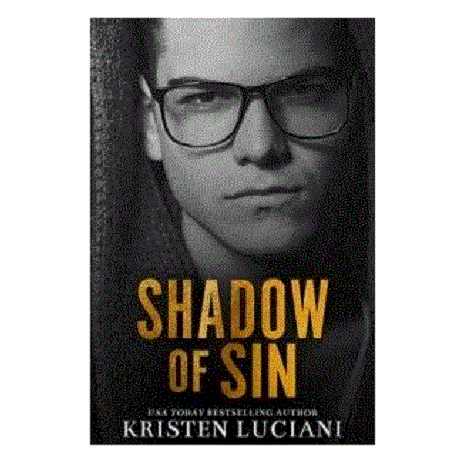
Some romances are built around the comforting idea that love makes life easier. Others are far more interested in what happens when love arrives at exactly the wrong moment, involving exactly the wrong person, in circumstances where trusting anyone could be dangerous.
Shadow of Sin by Kristen Luciani belongs firmly in the second category.
The second book in Luciani’s Deadly Sins series, Shadow of Sin is a dark mafia romance that combines romantic suspense, hacking, hidden identities, betrayal, forced proximity, and a morally gray hero. The story centers on Eva Moreno, a highly skilled hacker whose life has taught her that trust is a luxury she cannot afford, and Wolfe Molloy, a brilliant hacker whose ability to uncover secrets makes him perhaps the worst possible person for Eva to encounter—and, eventually, the one person she cannot escape.
The novel’s premise immediately establishes the central contradiction: Eva’s greatest skill is disappearing, while Wolfe’s greatest skill is finding people who do not want to be found.
That is a remarkably effective foundation for romantic suspense.
Eva has spent years learning how to erase herself from the digital world. Wolfe has spent years learning how to read the digital world. When their paths cross, the result is not simply attraction. It is a battle of intelligence, secrets, survival instincts, and emotional defenses.
And that is what makes Shadow Of Sin such an intriguing addition to Kristen Luciani’s growing collection of dark romances.
A Romance Where Trust Is the Most Dangerous Gamble
At the center of Shadow Of Sin is a heroine who has very good reasons not to trust anyone.
Eva’s backstory is immediately brutal. According to the book’s published synopsis, the last man she trusted sent her to prison for a crime she did not commit, while another person sold her brother to a Russian gangster and forced Eva into becoming a personal hacker.
Those experiences explain why Eva is so fiercely independent.
She is not simply the stereotypical “strong female character” who happens to be good with computers. Her ability to survive is rooted in distrust. She has learned that people can betray her, use her, exploit the people she loves, and disappear when she needs them most.
So when Wolfe enters her life, her first instinct is understandably not romance.
It is escape.
The problem is that Wolfe is exceptionally good at preventing escape.
That creates an immediate push-and-pull that gives the story much of its momentum. Eva wants freedom. Wolfe wants answers. Eva wants to remain invisible. Wolfe wants to understand her. And underneath those conflicting goals is an attraction neither character seems fully prepared to manage.
The romance therefore begins with a question that is much more interesting than simple physical attraction:
Can Eva ever trust someone capable of discovering everything she has tried to hide?
That question gives the relationship emotional stakes from the beginning.
Eva Moreno Is a Heroine Built for Dark Romance
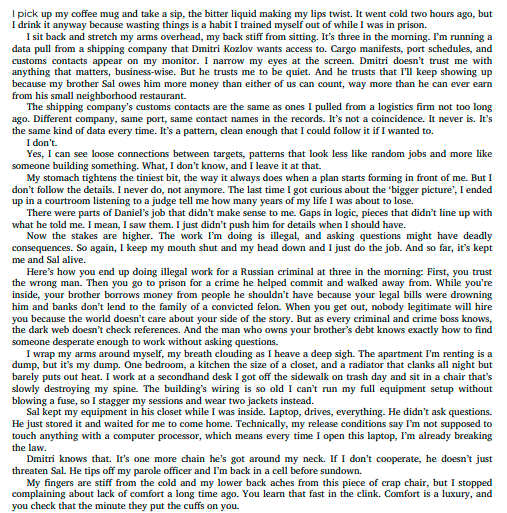
Eva is arguably the strongest element of the book.
She has the qualities readers expect from a dark-romance heroine—strength, independence, intelligence, resilience, and a willingness to fight back—but her character has an additional dimension because her skills are directly connected to her survival.
She is a hacker.
And not merely an inexperienced one.
The synopsis describes her as one of the best in Boston, capable of cracking systems, ghosting networks, and disappearing without leaving a trace.
That skill set makes her unusually well matched with Wolfe.
In many romantic-suspense stories, the heroine is placed in danger, and the hero becomes her protector. Shadow of Sin complicates that formula because Eva is dangerous in her own right.
She does not need someone to teach her how to survive.
She already knows how.
What she struggles with is something much more difficult: allowing another person to become important to her.
That distinction makes the romance more compelling.
Wolfe cannot simply rescue Eva and expect her to fall in love with him. He has to convince a woman who has every reason to distrust him that he will not become another person who takes advantage of her vulnerabilities.
And that is a much harder challenge.
Wolfe Molloy: Brilliant, Cold, and Morally Complicated
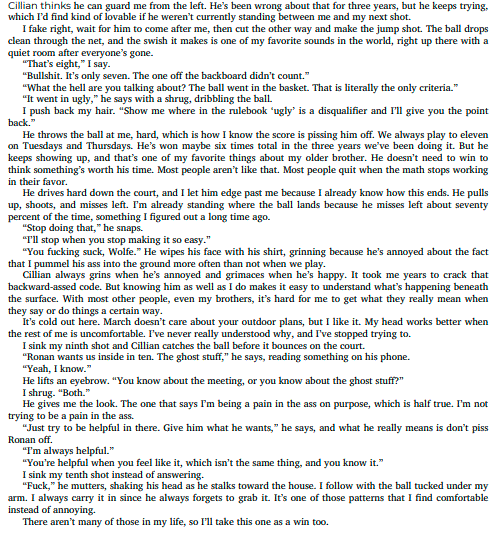
Wolfe is designed to appeal to readers who enjoy the morally gray hero.
He is described as a tech genius with an analytical mind, cold blue eyes, and an almost obsessive focus on Eva. His own perspective reveals an important contradiction: he claims not to do feelings, preferring data, patterns, and problems, yet Eva becomes the one problem he cannot solve.
That contradiction is central to his character.
Wolfe understands information.
He understands systems.
He understands patterns.
But emotions are considerably less predictable.
Eva therefore becomes something entirely new to him.
She is not simply a woman he finds attractive. She is an unsolved problem that gradually becomes an obsession.
The darker part of Wolfe’s characterization comes from his own admission that he possessed evidence that could have helped prove Eva’s innocence but chose to protect his family instead.
That choice changes everything.
It means Wolfe’s attraction to Eva exists alongside guilt.
He is not an uncomplicated savior.
He has already failed her.
And eventually, she is going to discover exactly how badly.
That gives the romance a strong foundation of conflict because Wolfe cannot simply claim that he cares about Eva. He has to confront the consequences of what he did.
The Hacker-versus-Hacker Dynamic Is a Major Strength
One of the most appealing elements of Shadow of Sin is the hacker-versus-hacker setup.
It is a clever romantic device because it creates equality between the protagonists.
Eva is not fascinated by Wolfe because he is simply more powerful than she is.
Wolfe is fascinated by Eva because she can actually challenge him.
Their professional abilities become part of their romantic chemistry.
Each understands the other’s mind in a way that other people may not. They recognize intelligence, strategy, caution, and technical skill in one another.
That creates a different kind of attraction.
It is not only physical.
It is intellectual.
Eva has spent her life hiding her capabilities because being noticed can be dangerous. Wolfe, meanwhile, is one of the few people capable of recognizing exactly how exceptional she is.
That recognition can be both flattering and frightening.
For a woman who has survived by staying invisible, being truly seen is a deeply vulnerable experience.
The Book’s Dark Atmosphere
The title Shadow of Sin is fitting because the novel’s atmosphere is built around secrets and consequences.
The characters are surrounded by things they cannot openly discuss. Past actions have present consequences. Loyalty is rarely straightforward. And the people who appear trustworthy may not be safe.
That atmosphere is essential to dark mafia romance.
The mafia setting gives the story an environment where power, family, loyalty, and violence overlap. The romance therefore develops in a world where emotional choices can have practical consequences.
A character cannot simply decide to trust someone without considering what that trust might cost.
A betrayal cannot necessarily be repaired with an apology.
And protecting someone may require making morally questionable choices.
This gives the romance an edge that a conventional contemporary love story would not have.
Betrayal Gives the Romance Its Emotional Backbone
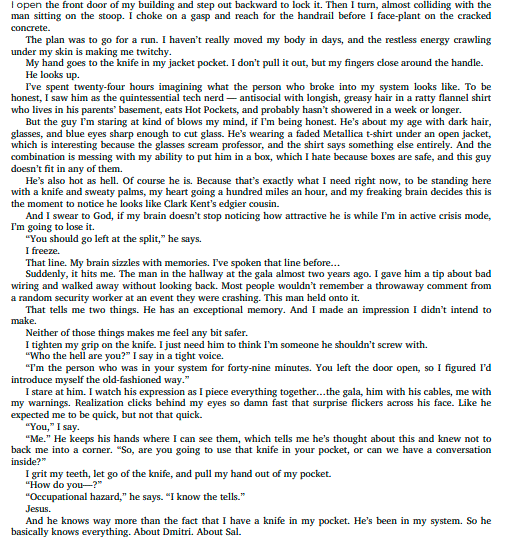
If there is one theme that seems to define Shadow of Sin, it is betrayal.
Eva has already experienced it.
Wolfe has committed it.
And the developing relationship has to survive it.
That is a powerful setup.
Many romance stories treat betrayal as a temporary obstacle. Someone makes a mistake, the truth comes out, there is an emotional confrontation, and the characters move forward.
A darker romance has the opportunity to take betrayal more seriously.
When someone has been betrayed repeatedly, trust does not return simply because another person apologizes.
Eva’s history makes forgiveness difficult.
Wolfe’s guilt makes earning that forgiveness even harder.
The result is a romance that has to deal with consequences rather than simply using conflict as decoration.
This is where the concept of an “earned grovel,” listed among the book’s tropes, becomes especially important.
Wolfe has something to make up for.
And readers who enjoy this particular romance trope will likely find that dynamic satisfying because the emotional payoff depends on him proving that his feelings are more powerful than his earlier decisions.
Forced Proximity Raises the Stakes
Forced proximity is another familiar dark-romance trope, but it works particularly well here because Eva and Wolfe are already emotionally opposed.
Put two people together who desperately want to understand each other, but who have every reason to remain guarded, and tension naturally follows.
Eva cannot simply disappear.
Wolfe cannot simply stop looking.
Their proximity therefore forces both characters to confront feelings they would probably prefer to avoid.
This also gives the story room to explore the difference between attraction and trust.
Two people can be physically close while remaining emotionally distant.
In fact, that contrast can create some of the strongest romantic tension.
The closer Eva gets to Wolfe, the more dangerous it becomes for her emotionally.
The more Wolfe learns about Eva, the more impossible it becomes for him to pretend she is simply another problem to solve.
A Romance Driven by Obsession
Obsession is one of the defining characteristics of Luciani’s dark-romance style, and Shadow of Sin embraces it.
Wolfe’s interest in Eva is not casual.
He becomes intensely focused on her, and the story uses that obsession as both a romantic fantasy and a source of danger.
This is where the book is likely to appeal most strongly to readers who enjoy possessive heroes.
The “touch her and die” trope is explicitly included among the book’s advertised tropes, alongside an obsessed hero and forced proximity.
These are familiar conventions, but the story’s hacker premise gives them an interesting modern edge.
Wolfe’s possessiveness is not merely physical.
He knows how to find people.
He knows how to track information.
He understands the digital world.
That makes his ability to locate Eva part of his character rather than simply a plot convenience.
For Eva, however, that ability is both attractive and terrifying.
The man who makes her feel safest is also the man most capable of invading the carefully constructed privacy that has kept her alive.
That contradiction is excellent dark-romance material.
The Mafia Element Adds External Pressure
The mafia backdrop gives Shadow of Sin more than atmosphere.
Eva’s brother has been sold to a Russian gangster, and the book’s synopsis places her story firmly within a dangerous criminal world.
That external pressure means the romance cannot exist in isolation.
There are bigger forces at work.
Family matters.
Loyalty matters.
Information matters.
Power matters.
And secrets can become weapons.
This allows Luciani to balance romantic tension with suspense. Just when the reader becomes invested in Eva and Wolfe’s emotional relationship, the surrounding danger reminds us that their problems are not limited to love.
That combination is one of the reasons romantic suspense can be so addictive.
The relationship creates emotional tension.
The external plot creates physical stakes.
Together, they keep the story moving.
The Emotional Question Behind the Suspense
The most interesting question in Shadow of Sin is not simply whether Eva and Wolfe will survive.
It is whether they can build a relationship after discovering the worst things about each other.
That is a much more difficult question.
Eva has to learn that Wolfe is not simply another person who will betray her.
Wolfe has to accept that caring for Eva does not erase what he did to her.
Love does not magically undo betrayal.
It does not erase trauma.
It does not restore trust overnight.
Instead, love has to prove itself through actions.
That is the emotional territory where the book has its greatest potential.
Kristen Luciani’s Strength as a Dark-Romance Author
Kristen Luciani has built an extensive bibliography around dark romance, mafia romance, and morally complicated relationships. Her books include series such as Ruthless Hearts Mafia, Severinov Bratva, Sinfully Savage, Vengeful Villains, and Obsidian Knights Secret Society.
That experience is relevant to Shadow of Sin because the book feels firmly situated within a genre Luciani knows well.
The combination of danger, obsession, family loyalty, morally gray heroes, and intense romantic stakes is not incidental.
It is part of the author’s established territory.
At the same time, the hacker-centered premise gives Shadow of Sin a slightly different identity from a traditional mafia romance.
Instead of focusing entirely on guns, family empires, and criminal hierarchy, the story introduces technology and information as forms of power.
That makes the central relationship feel modern.
In this world, knowing someone’s location can be as powerful as knowing their secrets.
And sometimes knowing someone’s secrets is even more dangerous.
What Makes Shadow Of Sin Stand Out?
The strongest feature of the book is its matching of the hero and heroine’s skills.
Eva and Wolfe are not opposites in intelligence.
They are rivals.
That makes their attraction more interesting.
Eva can disappear.
Wolfe can find her.
Eva can break into systems.
Wolfe can break back.
Eva is determined not to trust.
Wolfe is determined to understand her.
The romance therefore grows from conflict between equals rather than from a simple protector-and-victim dynamic.
That gives the book a strong identity within the crowded dark-romance market.
What May Not Work for Every Reader
As with any dark romance, Shadow of Sin is unlikely to appeal to everyone.
The story contains mafia violence, betrayal, morally gray behavior, obsession, wrongful imprisonment, criminal activity, and mature romantic themes. Readers who prefer lighthearted or emotionally uncomplicated romances may find the material too intense.
The relationship dynamics are also deliberately possessive and morally complicated.
That is part of the genre’s appeal, but readers should approach the book expecting fantasy rather than an example of an ideal healthy relationship.
Another consideration is that Shadow of Sin is the second book in the Deadly Sins series. Current bibliographic listings identify Marriage of Sin as Book 1 and Shadow of Sin as Book 2.
Readers may therefore get more enjoyment from experiencing the series in order, particularly if they want the broader world and character connections.
Is Shadow Of Sin Worth Reading?
For fans of dark mafia romance, the answer is likely yes.
The book brings together several popular romance tropes without relying on only one of them. There is the morally gray hero, the tough heroine, forced proximity, obsession, betrayal, hacking, hidden identities, suspense, and the promise of an earned emotional payoff.
But the most compelling element is the emotional contradiction at the center.
Wolfe is precisely the kind of man Eva should avoid.
He can find her.
He knows things about her.
He has already made a choice that hurt her.
And yet he is also the person who sees her most clearly.
For Eva, that creates an almost impossible emotional dilemma.
Can the person who knows how to break through every defense also become the person she trusts with her heart?
That question gives the romance its power.
The Best Thing About the Book
The best thing about Shadow of Sin by Kristen Luciani is the unique hacker-versus-hacker chemistry between Eva Moreno and Wolfe Molloy. Eva is an exceptionally skilled hacker who survives by staying hidden, while Wolfe is a tech genius who can uncover the identities, safe houses, and digital traces she has worked so hard to erase. Their opposing abilities immediately create a relationship built on tension, intelligence, and mutual fascination.
What makes this dynamic especially effective is that Eva is not written as a helpless heroine waiting to be rescued. She has a backbone, valuable skills, and the determination to protect herself. Wolfe may be powerful and obsessive, but Eva can challenge him intellectually, making their attraction feel like a meeting of two strong personalities rather than a one-sided relationship.
The emotional conflict is equally compelling. Wolfe has a devastating secret: he possessed evidence that could have helped prove Eva was innocent, but he chose to protect his family instead. Now that Eva is no longer a stranger to him, he has to face the consequences of that decision. His feelings for her therefore come with guilt, responsibility, and the need to earn her trust.
Another major strength is the combination of romance and suspense. The book brings together mafia danger, betrayal, hidden identities, forced proximity, obsession, and morally gray characters, giving the relationship much higher stakes than a conventional romance.
Ultimately, the strongest quality of Shadow of Sin is the way it turns trust into the central romantic challenge. Eva has every reason to protect her heart, while Wolfe has everything to prove. Their journey is not simply about falling in love—it is about discovering whether love can survive betrayal and whether someone who once failed you can eventually become the person you trust most.
That combination of intelligence, danger, emotional conflict, and obsessive chemistry is what makes Shadow of Sin stand out for fans of dark mafia romance and romantic suspense.
Why Do Readers Read This Book?
Readers are drawn to Shadow of Sin by Kristen Luciani because it combines dark mafia romance, romantic suspense, intense chemistry, and morally complicated characters. As the second book in the Deadly Sins series, the novel offers a high-stakes story centered on Eva Moreno and Wolfe Molloy, two exceptionally skilled hackers whose attraction develops in a world where trust can be dangerous.
One of the biggest reasons readers will pick up this book is the hacker hero × hacker heroine dynamic. Eva is an expert hacker who has survived by remaining hidden, while Wolfe is a technological genius capable of finding the digital traces she believes she has erased. Their opposing abilities create an unusual kind of romantic tension because neither character is simply waiting for the other to rescue them. They can challenge each other intellectually, making their attraction feel competitive as well as emotional.
Readers who enjoy morally gray and obsessive heroes are another natural audience for the book. Wolfe is not presented as a conventional romantic hero. He is intensely focused on Eva, protective of her, and willing to cross serious boundaries for the woman he loves. The book specifically features tropes such as an obsessed hero, “touch her and die,” forced proximity, and a morally gray hero.
The heroine’s story is equally compelling. Eva’s strength and resilience make her easy to root for. She has been wrongly imprisoned, betrayed, and forced into circumstances she never wanted, yet she continues to rely on her intelligence and determination to survive. Readers who enjoy heroines with a backbone are likely to appreciate that Eva is capable of protecting herself rather than being portrayed as helpless.
Another major attraction is the book’s focus on betrayal and redemption. Wolfe carries a painful secret: he had evidence that could have helped prove Eva’s innocence but chose to protect his family instead. Now that he has fallen for her, he must face the consequences of that decision. This creates an emotional conflict that goes beyond ordinary romantic tension because Wolfe has to earn the trust of the woman he previously failed.
Readers also come for the suspense and danger. The story combines mafia elements with hacking, hidden identities, family loyalty, criminal threats, and secrets from the past. These elements give the romance a sense of urgency because Eva and Wolfe are dealing with problems that cannot be solved simply by admitting their feelings.
The forced-proximity trope adds even more tension. Eva has built her life around disappearing when danger gets too close, but Wolfe is uniquely capable of finding her. That makes it difficult for her to maintain the emotional distance she normally uses as protection. Their circumstances force them to remain connected even when trusting each other feels risky.
The book also appeals to readers who enjoy dark romance with emotional stakes. Beneath the mafia danger and obsessive attraction is a story about trust, betrayal, forgiveness, and the possibility of rebuilding a relationship after serious mistakes. The emotional question is not simply whether Eva and Wolfe are attracted to each other, but whether their relationship can survive the truth about Wolfe’s past actions.
Finally, readers who already enjoy Kristen Luciani’s work have another reason to choose Shadow of Sin. Luciani has written extensively across dark romance, mafia romance, and romantic suspense, with numerous series featuring intense relationships and morally complicated characters. Shadow of Sin continues that established style while adding the distinctive hacker-centered premise.
Overall, readers choose Shadow Of Sin for its combination of dangerous romance, obsessive chemistry, intelligent protagonists, betrayal, suspense, and emotional redemption. It is particularly suited to fans of dark mafia romance who want more than a simple love story and enjoy relationships where trust must be fought for and earned.
In short, readers come for the mafia danger and intense romance, but the hacker-versus-hacker chemistry and Wolfe’s struggle to earn Eva’s trust are what make the story especially intriguing.
Final Verdict
Shadow of Sin by Kristen Luciani is a dark, suspenseful, and intensely romantic story that combines mafia danger with a surprisingly modern hacker-versus-hacker premise.
Eva Moreno is an especially strong heroine because her intelligence is not simply an attractive character trait—it is part of her survival. Her distrust is understandable, her independence is hard-earned, and her emotional vulnerability makes her relationship with Wolfe much more complicated than a typical dark-romance pairing.
Wolfe Molloy provides the perfect counterpart. Brilliant, emotionally guarded, morally gray, and increasingly obsessed with Eva, he is both the man most capable of understanding her and the man with the most to prove.
That contradiction drives the book.
The romance works because neither character is uncomplicated. Eva has to decide whether she can risk trusting again. Wolfe has to confront his own betrayal and prove that his devotion is worth believing.
Around them, the mafia world, digital espionage, hidden identities, and dangerous loyalties create the suspense necessary to keep the story moving.
The result is a romance that is not merely about two people falling for each other.
It is about two people who have built their entire lives around control, discovering that love is the one thing they cannot completely control.
Download Method: Shadow Of Sin by Kristen Luciani
By clicking on the download button below, you will initiate the download process of Shadow Of Sin by Kristen Luciani. The book is available in both ePub and PDF formats with a single click; moreover, we offer unlimited books for download without any spam, ad bombardment, flyers, or needless links. Your support in sharing with friends, family members, and colleagues is always welcome. Do not forget to share your ideas and thoughts in the comment section.
You may also like
Now and Then by Sara Miller PDF Download
Tough Call by L.A. Witt PDF Download
Zero Confusion by Ivy Glaze PDF Download
Just Like Summer by Aubree Pynn PDF Download

EPUB
Related posts:
 The Billionaire and the Beautician by Mallory Monroe PDF Download
 Her’s to Defend by Ashley Davis PDF Download
 Seven by N. N. Britt PDF Download
 Jury Woman by Stephanie Bond PDF Download
 Digging Up Love By Chandra Blumberg PDF Download
 Kian by Tijan PDF Download
 Crushed by A.K. Evans PDF Download
 BROKEN TRUST BY NANA MALONE PDF Download
 Terkel’s Twist by Dale Mayer PDF Download
 Dark Longing by Cassie Hargrove PDF Download