

Few books in fashion theory have had the intellectual influence and lasting academic importance of The Fashion System by Roland Barthes. First published in French in 1967, this complex yet groundbreaking work transformed the way scholars, critics, and designers think about clothing, communication, and culture. Rather than discussing fashion merely as fabric, aesthetics, or trends, Barthes approached fashion as a system of signs — a structured language capable of producing meaning, identity, aspiration, and social hierarchy.
For readers expecting a traditional fashion history book filled with glamorous imagery and designer anecdotes, The Fashion System can initially feel challenging, abstract, and highly theoretical. Yet beneath its dense academic surface lies one of the most original and intellectually ambitious examinations of fashion ever written.
Barthes was not interested in telling readers what was fashionable. He wanted to understand how fashion itself communicates. Why do certain garments signify elegance, authority, youth, femininity, or luxury? How do fashion magazines construct desire through language? What role does written description play in shaping our understanding of clothing before we even see the garment itself?
These questions form the intellectual foundation of the book, and Barthes explores them with remarkable rigor.
A Book That Changed Fashion Theory Forever
One of the reasons The Fashion System remains so important decades after publication is that it fundamentally altered the academic study of fashion.
Before Barthes, fashion was often dismissed by intellectual circles as superficial or commercially trivial. Serious scholars tended to focus on literature, philosophy, politics, or fine art while overlooking clothing as a meaningful cultural subject.
Barthes challenged that hierarchy.
Drawing heavily from semiotics — the study of signs and symbols — he argued that fashion operates like language. Clothing items function as signs that carry socially constructed meanings. A black dress, for example, is never simply a black dress. It may signify sophistication, mourning, minimalism, seduction, professionalism, or rebellion depending on cultural context.
This insight may seem familiar today because modern fashion criticism frequently discusses identity, symbolism, and representation. However, at the time Barthes introduced these ideas, they were revolutionary.
His work helped establish fashion studies as a legitimate academic discipline.
Roland Barthes Approaches Fashion Like a Linguist
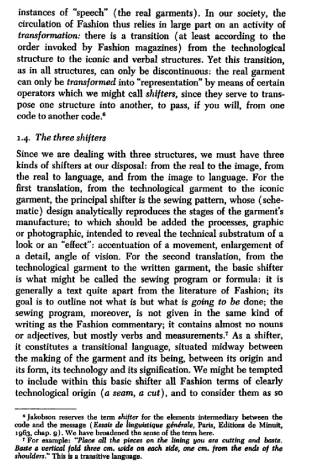
What makes this book uniquely fascinating is Barthes’ methodology. Instead of analyzing garments primarily through visual observation, he studies written fashion descriptions found in magazines.
This distinction is crucial.
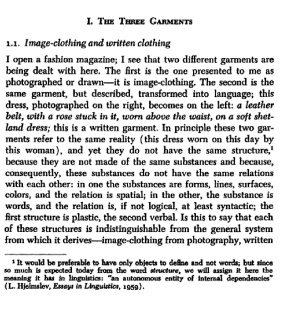
Barthes believed fashion media creates meaning not only through images but also through text. The descriptions accompanying garments — phrases about elegance, seasonality, femininity, texture, or sophistication — shape how readers interpret clothing.
He separates fashion into multiple categories:
- Real clothing
- Photographed clothing
- Written clothing
The concept of “written clothing” becomes central to the book. Barthes dissects fashion journalism almost sentence by sentence, examining how language transforms ordinary garments into symbolic objects charged with cultural meaning.
For example, a magazine might describe a dress not merely as practical attire but as “youthful,” “romantic,” or “Parisian.” These words create emotional associations that extend beyond the physical object itself.
Barthes demonstrates that fashion language is carefully constructed to generate fantasy and aspiration.
This analytical approach remains astonishingly relevant in today’s world of influencer culture, luxury branding, and social media marketing.
The Book Is Dense but Intellectually Rewarding
There is no denying that The Fashion System is a demanding read.
Unlike contemporary fashion books designed for casual audiences, Barthes writes with philosophical precision and academic complexity. Readers unfamiliar with structuralism, linguistics, or semiotic theory may initially struggle with the terminology and conceptual density.
The book requires patience.
Barthes frequently breaks down linguistic structures in painstaking detail, analyzing grammar, syntax, and symbolic relationships with almost scientific intensity. At times, the reading experience can feel more like studying philosophy or advanced literary criticism than reading about fashion.
However, for readers willing to engage deeply with the material, the intellectual rewards are substantial.
The complexity is not empty academic performance. Barthes is constructing an entirely new framework for understanding how fashion operates culturally.
His ideas encourage readers to think beyond surfaces. Fashion stops being merely decorative and becomes a sophisticated system of communication tied to class, gender, aspiration, ideology, and consumer culture.
This shift in perspective is one of the book’s greatest achievements.
Fashion as a Cultural Language
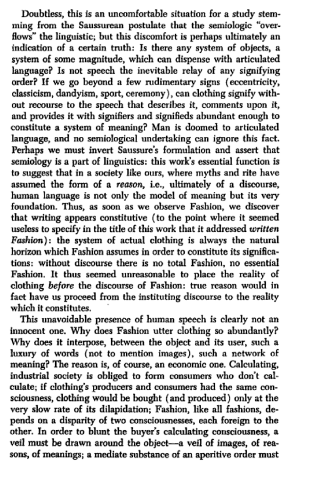
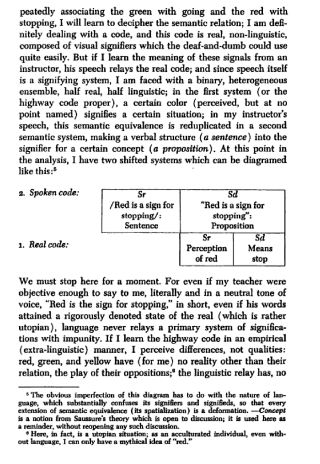
One of Barthes’ most enduring contributions is his argument that fashion functions as a social language governed by codes and conventions.
Just as spoken language relies on grammar and vocabulary, fashion relies on symbolic structures that societies collectively understand.
Certain silhouettes imply professionalism.
Certain fabrics suggest luxury.
Certain colors communicate authority, innocence, rebellion, or sensuality.
Barthes argues that these meanings are not natural but culturally produced.
This insight remains highly relevant in contemporary fashion discussions surrounding identity politics, branding, gender expression, and digital aesthetics.
Modern fashion consumers may not consciously analyze garments semiotically, but they constantly interpret clothing symbolically.
Luxury logos communicate status.
Streetwear signals cultural affiliation.
Minimalism suggests sophistication.
Vintage clothing evokes nostalgia.
Barthes anticipated these conversations decades before they became mainstream cultural discussions.
The Book’s Influence on Modern Fashion Criticism
It is difficult to overstate the impact The Fashion System has had on fashion theory, media studies, cultural criticism, and design education.
The book influenced generations of:
- Fashion scholars
- Cultural theorists
- Journalists
- Designers
- Art critics
- Media researchers
Many contemporary discussions about branding, visual culture, identity construction, and consumer symbolism can be traced back to Barthes’ theoretical groundwork.
Even fashion advertising today reflects concepts Barthes explored. Luxury campaigns rarely sell clothing based solely on practicality. Instead, they sell narratives, moods, lifestyles, and symbolic identities.
A handbag becomes empowerment.
A suit becomes authority.
A fragrance becomes seduction.
Barthes recognized that fashion industries manufacture meaning as much as they manufacture garments.
That observation feels even more relevant in the age of Instagram and digital self-presentation.
The Writing Is Challenging but Brilliant
Roland Barthes possessed one of the most distinctive intellectual voices of the twentieth century. His writing combines philosophical depth with analytical sharpness, although it undeniably demands concentration from readers.
Unlike accessible pop-fashion writers, Barthes assumes intellectual engagement. He does not simplify ideas for convenience.
At times, this density may frustrate casual readers seeking straightforward arguments or practical fashion commentary. Some passages feel highly abstract, particularly when Barthes examines linguistic systems in technical detail.
Yet there is also remarkable precision in his writing.
Every concept feels carefully considered.
Every distinction matters.
Readers interested in critical theory or philosophy may appreciate the elegance of Barthes’ structural thinking even when the material becomes demanding.
Importantly, the book rewards rereading. Many of Barthes’ insights become clearer and more powerful over time.
Not a Beginner-Friendly Fashion Book
One of the most important things potential readers should understand is that The Fashion System is not an introductory fashion book.
It is not primarily about:
- Fashion history
- Designer biographies
- Styling advice
- Garment construction
- Trend forecasting
Instead, it is a theoretical investigation into how fashion creates meaning through language and representation.
Readers expecting visual inspiration or practical design instruction may find themselves disappointed or overwhelmed.
This book is best suited for:
- Fashion theory students
- Cultural studies scholars
- Media researchers
- Fashion journalists
- Philosophically curious readers
- Advanced design students
For these audiences, however, the book becomes deeply rewarding.
The Book’s Lasting Relevance in the Digital Age
Perhaps the most impressive aspect of The Fashion System is how contemporary it still feels.
Although written in the 1960s, Barthes’ analysis anticipated many modern realities of digital fashion culture.
Today, fashion is increasingly mediated through screens, captions, hashtags, influencer branding, and curated online identities. Consumers often encounter fashion first through language and media framing rather than physical experience.
Social media has intensified exactly the kind of symbolic communication Barthes studied.
Instagram captions, luxury campaigns, TikTok aesthetics, and influencer styling all rely on coded meanings and aspirational narratives.
Fashion remains a language of signs.
Barthes understood this long before digital culture emerged.
His ideas continue helping readers decode how fashion industries shape desire, status, identity, and social aspiration.
That enduring relevance explains why the book remains foundational within academic fashion studies.
Strengths of The Fashion System
The book’s greatest strengths include:
Intellectual Originality
Barthes approached fashion from a perspective few scholars had previously considered.
Theoretical Depth
The analysis is rigorous, ambitious, and philosophically rich.
Cultural Insight
The book reveals how deeply fashion connects to identity, communication, and ideology.
Academic Influence
Its impact on fashion studies and cultural criticism remains enormous.
Timeless Relevance
Many of Barthes’ ideas feel even more applicable today than when originally published.
Weaknesses and Limitations
Despite its brilliance, the book is not without limitations.
Dense Academic Language
The writing can feel intimidating and inaccessible to general readers.
Limited Visual Focus
Readers seeking visual fashion inspiration may find the text overly abstract.
Repetitive Analysis
Some sections become highly technical and repetitive due to Barthes’ detailed linguistic methodology.
Narrow Scope
The focus on written fashion descriptions occasionally limits discussion of material craftsmanship or garment construction.
However, many of these limitations stem directly from the book’s intellectual goals rather than flaws in execution.
Barthes was intentionally conducting a rigorous semiotic study, not writing a mainstream fashion commentary.
Final Verdict – A Landmark Work in Fashion Theory
The Fashion System remains one of the most intellectually important books ever written about fashion. It transformed clothing from a superficial consumer topic into a serious subject of philosophical and cultural inquiry.
Roland Barthes challenged readers to see fashion not simply as style but as language — a system of symbols through which societies communicate identity, aspiration, gender, status, and ideology.
The book is undoubtedly demanding, and it requires patience, concentration, and intellectual curiosity. Casual readers may struggle with its academic density. Yet for those willing to engage deeply with its ideas, The Fashion System offers profound insight into how fashion shapes meaning in modern culture.
More than fifty years after publication, Barthes’ theories continue influencing fashion criticism, media studies, branding analysis, and cultural theory.
That enduring relevance is the mark of a truly great intellectual work.
Best For:
- Fashion theory students
- Cultural critics
- Media scholars
- Fashion journalists
- Advanced design researchers
Not Ideal For:
- Casual fashion readers
- Beginners seeking practical design instruction
- Readers looking for visual fashion inspiration
Key Takeaway
Fashion is never just clothing. According to Roland Barthes, it is a language society uses to construct meaning, desire, and identity.
Available Formats
EPUB
Book Innformation In Point
1. Book Title
The Fashion System
2. Author
Roland Barthes
3. Original Title
Système de la Mode (French)
4. Genre
Fashion Theory / Semiotics / Cultural Studies / Philosophy
5. First Publication Year
1967 (French Edition)
6. English Translation Published
1983
7. Publisher
Hill and Wang (English Edition)
8. Language
Originally written in French
9. Number of Pages
Approximately 300–320 pages depending on edition
10. ISBN
- ISBN-10: 0809046607
- ISBN-13: 9780809046607
11. Book Overview
The book examines fashion as a system of communication and meaning rather than simply clothing or style. Roland Barthes analyzes how fashion magazines use language, descriptions, and symbols to create cultural meaning and influence society.
12. Main Topics Covered
- Fashion semiotics
- Fashion language
- Symbolism in clothing
- Cultural meaning of fashion
- Media and communication
- Structuralism
- Written fashion descriptions
- Fashion and identity
- Signs and symbols in culture
13. Core Idea of the Book
Fashion functions like a language where clothing acts as signs that communicate identity, status, gender, and cultural values.
14. Writing Style
Highly intellectual, analytical, theoretical, and academic.
15. Best For
- Fashion theory students
- Cultural studies researchers
- Media scholars
- Fashion journalists
- Philosophy readers
- Advanced fashion academics
16. Educational Value
Considered one of the most influential books in fashion theory and semiotics. Frequently studied in universities and fashion studies programs.
17. Key Strengths
- Original intellectual approach
- Deep cultural analysis
- Revolutionary fashion theory
- Strong academic influence
- Timeless relevance
18. Weaknesses
- Difficult for beginners
- Dense academic language
- Limited visual content
- Requires patience and concentration
19. Why This Book Is Important
The book helped establish fashion studies as a serious academic discipline and changed how scholars analyze fashion, branding, and visual culture.
20. Influence on Modern Fashion Studies
Its theories continue influencing:
- Fashion criticism
- Branding analysis
- Media studies
- Luxury marketing
- Social media fashion culture
- Identity studies
21. Famous Concept
Barthes introduced the idea that fashion is a “system of signs” similar to language.
22. Author Background
Roland Barthes was a French philosopher, literary critic, and semiotician known for his influential work in structuralism, media theory, and cultural analysis.
23. Target Audience
Primarily academic and intellectually curious readers rather than casual fashion enthusiasts.
24. Overall Rating
9/10
25. Recommended For
Readers interested in understanding the deeper cultural, symbolic, and psychological meanings behind fashion and media.
Download Method The Fashion System by Roland Barthes
By Clicking on the below download button, you will initiate the downloading process of The Fashion System by Roland Barthes.The book is available in both ePub and PDF format with a single click, moreover we offer unlimited books for downloading without any spams, bombardment of ads. Flyers and needless links. Your support in regard to sharing with friends, family members, colleagues are always welcome. Do not forget to share your ideas and thoughts in the comment section.
You may also like
Fashionpedia by Fashionary PDF Download
Worn by Sofi Thanhauser PDF Download
Fashion by DK PDF Download
Patternmaking For Fashion Design by Helen Joseph Armstrong’s PDF Download

Related posts:
 Fashion Upcycling by Ysabel Hilado PDF Download
 Fashion Design Course by Steven Faerm PDF Download
 Fashion Sketchbook by Bina Abling PDF Download
 Patternmaking For Fashion Design by Helen Joseph Armstrong’s PDF Download
 Fashion by DK PDF Download
 Worn by Sofi Thanhauser PDF Download
 Fashionpedia by Fashionary PDF Download