
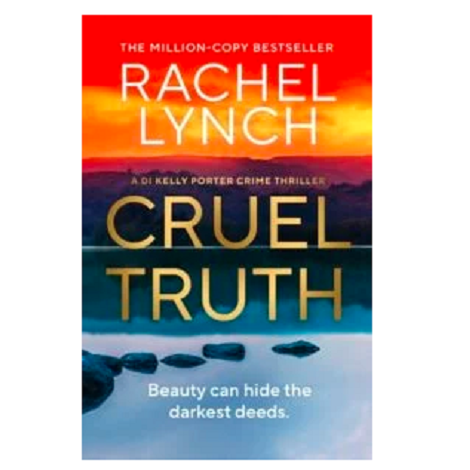
Cruel Truth by Rachel Lynch is a contemporary crime thriller that combines psychological tension with investigative procedural elements. As part of modern British crime fiction, the novel engages with themes of deception, trauma, and the moral ambiguities that often underpin both criminal acts and their investigation. Lynch, known for her ability to craft suspenseful narratives grounded in human psychology, uses Cruel Truth to explore the intersection between personal history and criminal behavior.
The novel operates within a familiar framework of crime fiction—an investigation led by law enforcement, a complex case with hidden layers, and a gradual revelation of truth. However, its effectiveness lies not merely in plot mechanics but in its attention to psychological depth and emotional stakes. This review examines the novel’s narrative construction, thematic concerns, character development, stylistic approach, and its strengths and limitations within the crime thriller genre.
Plot Overview (Contextual Summary)
At its core, Cruel Truth follows an investigation into a disturbing crime that initially appears straightforward but gradually reveals deeper complexities. The narrative is driven by a central investigator—often a recurring figure in Lynch’s work—who must navigate both professional challenges and personal pressures while uncovering the truth behind the case.
As the investigation progresses, layers of deception emerge. Witnesses prove unreliable, motives are obscured, and the line between victim and perpetrator becomes increasingly blurred. The novel builds suspense through a series of revelations that challenge initial assumptions, leading to a climax that recontextualizes earlier events.
While the plot adheres to the conventions of procedural crime fiction, it distinguishes itself through its focus on psychological realism and emotional consequences.
Themes
1. The Nature of Truth
The concept of “truth” is central to the novel, as suggested by its title. Lynch interrogates the idea that truth is not always objective or easily accessible. Instead, it is fragmented, shaped by perception, memory, and personal bias.
Throughout the investigation, characters present conflicting accounts, forcing both the protagonist and the reader to question what is real. This thematic focus reflects a broader trend in contemporary crime fiction, where certainty is replaced by ambiguity.
2. Trauma and Its Consequences
Trauma plays a significant role in shaping character behavior and motivations. The novel explores how past experiences influence present actions, often in ways that are not immediately visible.
Rather than presenting trauma as a simple explanatory device, Lynch portrays it as complex and multifaceted. Characters are not defined solely by their experiences but are nevertheless deeply affected by them.
3. Moral Ambiguity
One of the novel’s strengths is its refusal to present a clear-cut moral landscape. Characters operate in shades of gray, and actions that might initially seem unjustifiable are later contextualized.
This moral complexity enhances the narrative’s realism and challenges the reader to reconsider simplistic notions of good and evil.
4. Isolation and Psychological Strain
The investigative process is depicted as isolating, both professionally and emotionally. The protagonist’s dedication to uncovering the truth often comes at a personal cost, highlighting the psychological toll of such work.
This theme adds depth to the narrative by emphasizing that solving a crime is not merely an intellectual exercise but an emotionally demanding process.
Character Analysis
The Investigator
The central investigator serves as the narrative anchor. Lynch portrays this character as competent and determined but also humanly flawed. Personal struggles—whether related to past experiences, relationships, or internal conflicts—add depth to the character.
This balance between professionalism and vulnerability makes the protagonist relatable and enhances reader engagement.
Supporting Characters
Supporting characters are carefully constructed to serve both narrative and thematic functions. Suspects, victims, and witnesses each contribute to the unfolding mystery, often embodying different aspects of the novel’s central themes.
While some characters may initially appear archetypal, they are frequently given additional layers that complicate reader expectations.
Narrative Style and Structure
1. Controlled Pacing
Lynch demonstrates a strong command of pacing. The narrative unfolds gradually, allowing tension to build without overwhelming the reader. Key revelations are strategically placed to maintain suspense.
2. Alternating Perspectives
The use of multiple perspectives, if present, adds complexity to the narrative. By presenting different viewpoints, Lynch reinforces the theme of fragmented truth.
3. Clear and Direct Prose
The writing style is clear, concise, and functional, which suits the demands of the thriller genre. Rather than drawing attention to itself, the prose serves the story, ensuring that the plot remains the primary focus.
Strengths of the Novel
1. Psychological Depth
The novel excels in its exploration of character psychology. Motivations are carefully developed, and emotional responses feel authentic.
2. Thematic Cohesion
The focus on truth, trauma, and moral ambiguity is consistently maintained throughout the narrative, giving the novel a strong thematic core.
3. Engaging Mystery
The central mystery is compelling, with enough twists and turns to keep readers invested without becoming overly convoluted.
4. Realistic Portrayal of Investigation
The procedural aspects of the story are handled with attention to detail, enhancing the novel’s credibility.
Limitations and Critique
1. Familiar Genre Conventions
While well-executed, the novel relies on established crime thriller tropes. Readers familiar with the genre may find certain elements predictable.
2. Emotional Distance at Times
Although the novel explores deep themes, there are moments where emotional engagement may feel slightly restrained due to the focus on procedural detail.
3. Supporting Character Depth
Some secondary characters may not receive the same level of development as the protagonist, limiting their impact.
Comparative Perspective
Within contemporary crime fiction, Cruel Truth aligns with works that prioritize psychological realism over sensationalism. It shares similarities with other British crime novels that emphasize character-driven narratives and moral complexity.
Compared to more fast-paced thrillers, Lynch’s approach is more measured and introspective, focusing on the investigative process and its emotional implications rather than constant action.
Conclusion
Cruel Truth by Rachel Lynch is a compelling and thoughtfully constructed crime thriller that combines an engaging mystery with meaningful thematic exploration. Its strengths lie in its psychological depth, moral complexity, and careful narrative structure.
While it may not radically innovate within the genre, it demonstrates a high level of craftsmanship and a clear understanding of what makes crime fiction compelling. The novel’s exploration of truth as a fluid and contested concept adds intellectual weight to its suspenseful narrative.
Ultimately, Cruel Truth succeeds as both a gripping mystery and a reflective study of human behavior, making it a valuable contribution to contemporary crime literature.
Available Formats
EPUB
BOOK INFORMATION IN POINT
- Title: Cruel Truth
- Author: Rachel Lynch
- Genre: Crime Thriller / Psychological Crime Fiction Police Procedurals Women Sleuths
- Language: English
- Form: Novel (Fiction)
- Main Focus: Criminal investigation involving hidden motives, deception, and psychological complexity
- Themes:
- Truth vs. deception
- Trauma and psychological impact
- Moral ambiguity
- Justice and investigation
- Human behavior under pressure
- Setting: Contemporary real-world environment (police/investigative backdrop)
- Main Character: A law enforcement investigator leading the case
- Supporting Characters: Suspects, victims, and witnesses linked to the central crime
- Narrative Style: Clear, direct, investigative, and psychologically focused
- Tone: Suspenseful, serious, tense, and analytical
- Structure: Linear crime investigation with unfolding revelations and twists
- Target Audience: Readers of crime fiction, psychological thrillers, and police procedurals
Download Method Cruel Truth by Rachel Lynch
By Clicking on the below download button, you will initiate the downloading process of Cruel Truth by Rachel Lynch.The book is available in both ePub and PDF format with a single click, moreover we offer unlimited books for downloading without any spams, bombardment of ads. Flyers and needless links. Your support in regard to sharing with friends, family members, colleagues are always welcome. Do not forget to share your ideas and thoughts in the comment section.
You may also like
Hearts Entangled In Winter’s Fury by Donna Kessler PDF Download
Protecting Their Omega by Sadie Moss PDF Download
Shut Up And Kiss Me by Giulia Lagomarsino PDF Download
The Last Drop of Hemlock by Katharine Schellman PDF Download

EPUB
Related posts:
 The Dancing Girls by M.M. Chouinard PDF Download
 Hide by Tracy Clark PDF Download
 Framed in Death by J. D. Robb PDF
 The Girl from Devil’s Lake by J. A Jance PDF Download
 The Invisible Woman by James Patterson PDF Download
 I’m Not the Only Murderer in My Retirement Home by Fergus Craig PDF Download
 When the Fields Go Quiet by Kennedy Layne PDF Download
 Chilled by Kendra Elliot Free Download
 The Last Move by Mary Burton Free Download
 Gated Prey by Lee Goldberg Free Download